 |
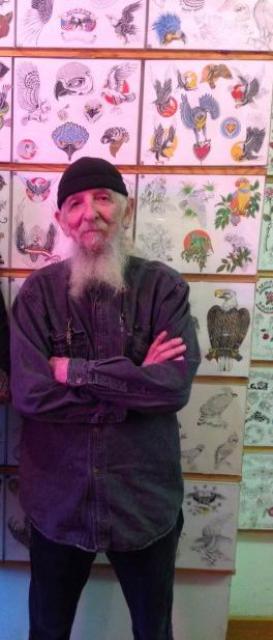
Mehai BakatyNew York tattoo artist, owner of Fineline Tattoo Parlor
Country:
 USA USA |
Content:
- Fineline Tattoo: A New York City Icon
- From Underground to Mainstream
- A Relic of the Past
- Evolution of the Tattoo Culture
- A Safe Haven for All
- A New Era
- The Art of Tattooing
- Current Trends and the New York Style
- Regarding a distinct New York City tattoo style, Bakaty notes:
- Memorable Clients
- Advice for First-Timers
Fineline Tattoo: A New York City Icon
Amidst the tattoo taboo in 1961 New York City, Michael Bakaty Sr. boldly established 'Fineline Tattoo'. Operating illicitly from 1976 on the Lower East Side's Bowery, Bakaty gradually amassed a clientele amidst a citywide crackdown. This thriving subculture was sustained by pioneers like Michael, honing their craft under the shadow of potential legal repercussions.
From Underground to Mainstream
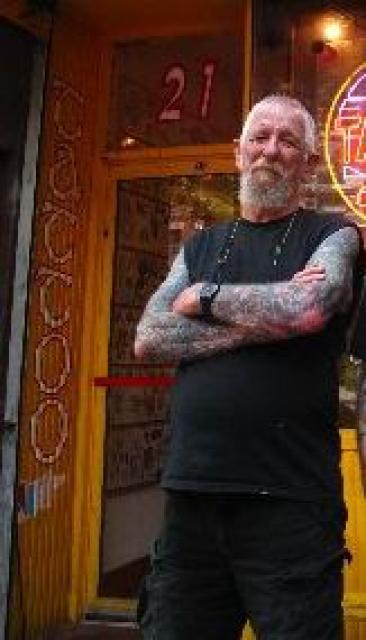
When the ban was lifted in 1997, 'Fineline' emerged from the underground, relocating to the East Village's 21 First Avenue, where it remains today. The mantle was passed down to Michael Bakaty Jr., who now not only owns New York City's longest-standing tattoo parlor but also continues to work as a tattoo artist.
A Relic of the Past
In an era of upscale tattoo boutiques, 'Fineline' stands alone as a relic of a bygone era, an old-school establishment "without all the frills." It offers an unassuming ambiance steeped in tattoo history. Marking the 40th anniversary of its illicit origins, Bakaty reflects on 'Fineline Tattoo's journey:
> "The Lower East Side was always kind of the poor neighborhood, the low-rent district. But it seems like, in the past few years, it's like a luxury hotel is going up every other block.
> "The rents are going up, so the small businesses here and there are starting to dry up. But we are still here, thankfully, due to the support of our clientele and the neighborhood in general."
Evolution of the Tattoo Culture
Bakaty recalls the illicit nature of New York City's tattoo culture in the past:
> "You know, New York City used to be lawless, back in the day. Back in the 1980s, you couldn't get a cab to go past 14th Street. Tattooing during the ban was like it was in the shadows. There was really no way to advertise, other than the back pages of 'The Village Voice'."
> "People would come to you because of word-of-mouth. You really had to be in the know or really want a tattoo to seek someone out. There were so few people who tattooed in the city during the '70s and '80s."
A Safe Haven for All
Despite the risks involved, 'Fineline Tattoo' became a haven for all walks of life:
> "When I was growing up, our tattoo shop was in the back of a loft. It was a proper shop, built out like a professional shop. And we would get people from all different walks of life—cops, teachers, lawyers, actors, drug dealers, people from all walks of life.
> "I remember a couple of times where it would be like members of, what seemed to be, rival gangs in the shop at the same time. It would always be crazy tension in the air, but everyone would always be respectful because this is a sacred tattoo shop."
A New Era
Bakaty, having witnessed the evolution of the tattoo industry, credits New York City as a major catalyst:
> "When I was a kid, the tattooing scene, like the whole city, was very, very different. I think the culture started moving before the ban was lifted. I'd say that it just shifted overnight here in New York City.
> "When I think about it now, I feel like overnight it happened everywhere in the world. There's so much more interest than even 20 years ago. You can't argue with that."
The Art of Tattooing
Over the years, Michael has created countless tattoos, from full-body suits to intricate designs. While pinpointing a favorite is challenging, he reveals:
> "It's really hard to choose, but I'll tell you what. There have been certain individuals that I've tattooed that I've been able to develop a really deep, close relationship with. To me, that's a lot more dear to me than the tattoo itself. I just love what I do, and the fact that my next favorite tattoo could be the next great thing."
Current Trends and the New York Style
Reflecting on trends, Michael observes:> "The trends are funny. They definitely happen, but they don't really last too long. Right now, I would say the big script tattoos—quotes and stuff like that—are the trend.
> "But I'm not so sure that that's ever not been a thing. There is a huge resurgence, also, in classic American traditional tattooing these days. So I would say the Americana stuff, the old classics, is definitely a trend right now."
Regarding a distinct New York City tattoo style, Bakaty notes:
> "New York City tattooing is a prime example of what is generally defined as 'East Coast style,' the bold black-and-color outlines.
> "I think the ethnic diversity in New York keeps imagery fresh and constantly changing. I would also say that New York style goes hand in hand with global style."
Memorable Clients
When asked about unusual clients, Michael acknowledges that "strange" is subjective. Nonetheless, he recalls one encounter that baffled him:
> "None of us wanted to do it. But my father being a good guy, he agreed to do it. This guy wanted a nude pin-up girl on his leg. My father quoted him a price, and the guy didn't even flinch.
> "The guy starts taking off pants after pants. Four pairs of pants, in the middle of July. The fumes in the shop, we had to keep the front door open. But my father finished the tattoo. As the guy started putting his clothes back on, I figured he was going to stiff us.
> "Instead, the guy reaches in his pants and pulls out one of the biggest wads of hundred-dollar bills that I've ever seen. He paid for the tattoo and walked out the door with dignity—not fast enough for me because of the smell."
Advice for First-Timers
To those contemplating their first tattoo, Michael advises patience and choosing something they truly love, "something you can grow with." Additionally, he recommends finding an artist who resonates with them and who they can tolerate spending time with during the sometimes painful tattooing process.