 |
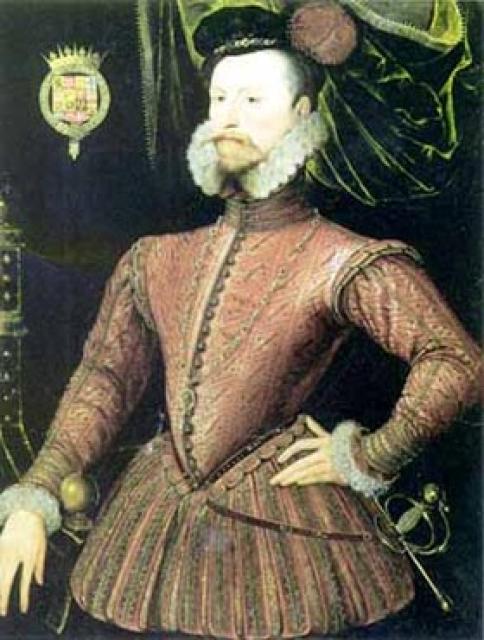
Robert Dadly LesterFavorite of Queen Elizabeth of England, youngest son of the Duke
Country:
 Great Britain Great Britain |
Content:
- Biography of Robert Dudley
- The Tragic Love Story
- The Plot to Crown Lady Jane Grey
- Imprisonment and Secret Romance
- A Miraculous Escape from Execution
- Fall from Grace and Secret Visits
- The Reign of Queen Mary
- Return to Favor and Marriage
- Love Triangle and Tragic Death
- The Virgin Queen
- The Rivalry
- The Rise of Walter Raleigh
- The Tragic End
Biography of Robert Dudley
The Favorite of Queen ElizabethRobert Dudley was the favorite of Queen Elizabeth, the younger son of the Duke of Northumberland. The relationship between Queen Elizabeth and Lord Dudley was one of the most remarkable love stories in history.
The Tragic Love Story
The beautiful Anne Boleyn, Elizabeth's mother, was executed in 1536 because her husband, Henry VIII, wanted to marry Jane Seymour. Jane died during childbirth. The king had three more wives, but none of them bore him children. When a son was born to him, the inheritance rights of his daughters from previous marriages were taken away. However, when the son proved to be sickly, the rights of the daughters were restored. After the death of Henry VIII, intrigue for the throne began.
The Plot to Crown Lady Jane Grey
The Duke of Northumberland influenced young Edward VI to make his distant relative, Lady Jane Grey, the heir to the throne. The royal children, who were all under sixteen, had a deep affection for each other. They might have married, but the Duke of Northumberland had other plans. He secretly married Lady Jane Grey to his son, Lord Guildford Dudley. He then poisoned his son and kept his death a secret for several days, in order to hold the funeral simultaneously with Jane's coronation. Jane was made queen against her will, while she mourned her deceased husband. However, her reign lasted only two weeks. Mary Tudor, citing her father's will, proclaimed herself queen in 1553.
Imprisonment and Secret Romance
Mary immediately arrested Jane, and when several conspirators attempted to overthrow her, she ordered the secret execution of the unfortunate woman, fearing that her beauty, youth, and innocence would evoke sympathy from the people. At the same time, Mary ordered the imprisonment of her sister Elizabeth in the Tower, suspecting her of involvement in the plot. Elizabeth was only twenty years old at the time, with her fair hair, beautiful blue eyes, aquiline nose, and rosy cheeks - she was the epitome of a future queen. She carried herself with such dignity that there was no doubt she aspired to the throne. The imprisonment was particularly painful for her, as her heart burned with passion for Robert Dudley, the future Earl of Chester - a twenty-two-year-old charmer, elegant, gallant, always well-dressed, and perfectly suited to win the heart of the queen.
A Miraculous Escape from Execution
Robert Dudley miraculously escaped the executioner's block, and it was only his beauty that saved him. When the furious Queen Mary was about to pronounce his sentence, she was struck by his otherworldly beauty and pardoned him. Dudley couldn't hold back his tears.
Fall from Grace and Secret Visits
Robert Dudley was raised alongside Edward VI, but after his father's execution and the Wyatt rebellion, he fell out of favor and was imprisoned in the Tower. He was stripped of his noble rights and all his possessions. Elizabeth fell in love with him at first sight. Astrologers later explained that they were born under the same constellation, although Dudley was two years older. Anyway, the princess was captivated by the seductive gaze of the young man, his alluring voice, and his speeches full of genuine sympathy. It is uncertain whether the young lord won the heart of the beautiful prisoner while in captivity or later. He was released from prison five years before Elizabeth, thanks to the intervention of Philip II of Spain, who was married to Mary, Elizabeth's half-sister.
The Reign of Queen Mary
Mary pursued her own desires: she relentlessly persecuted Protestants, introduced the Inquisition in England, and signed over 500 death sentences during her short and "bloody" reign. However, Mary failed to keep her Spanish husband by her side. He left her and returned to his homeland.
Return to Favor and Marriage
Robert Dudley was fully pardoned and his rights and titles were restored when he returned to England. He secretly visited Elizabeth in Woodstock, where she lived, forgotten by everyone. Parliament, in favor of Mary Tudor, declared Henry VIII's marriage to Anne Boleyn invalid, and Elizabeth illegitimate, thereby depriving her of any hope of ascending the throne. Mary agreed to let Elizabeth move from Woodstock to a more comfortable place. Elizabeth settled in the secluded castle of Hatfield, where she diligently pursued her studies, learning languages, and indulging in gardening in her free time.
Love Triangle and Tragic Death
Elizabeth continued to meet Dudley, who, to avoid scandal and protect the reputation of his future queen, married a noble and wealthy lady, Amy Robsart. This marriage was later immortalized in Walter Scott's novel. When Mary Tudor died of dropsy in 1558, without producing an heir to the throne, Elizabeth became the queen and the undisputed ruler of England. She was immediately surrounded by enthusiastic supporters, including Philip II of Spain, who had courted her before.
The Virgin Queen
Elizabeth despised Philip II as a fanatical Catholic, but she never revealed her true feelings. When she ascended the throne, she declared her intention to remain a virgin for the glory of God and the good of the state. She showed her parliamentarians her coronation ring, which she had not removed since the ceremony, and proclaimed that she was already betrothed to her spouse, to whom she would remain faithful until death. Her spouse was England, and her subjects were her children. She vowed to choose the most worthy man as her husband, but until then, she wished for her tombstone to bear the inscription: "She lived and died a queen and a virgin."
The Rivalry
Elizabeth had no shortage of suitors. In the early years of her reign, the Earl of Arundel borrowed a large sum of money from an Italian merchant, which he generously spent on entertainment and bribing the queen's friends and servants to persuade her to "get married." Many sought her hand in marriage, including Elector Palatine Casimir, Archduke Charles of Austria, and Duke of Holstein, among others. Gillenstern, the Swedish envoy at the English court, learned about the tender relationship between Elizabeth and Dudley and informed Eric XIV of Sweden, who ordered him to hire an assassin for £10,000 to kill the favorite.
The Rise of Walter Raleigh
Unable to marry Elizabeth, Dudley took it upon himself to introduce her to the most beautiful young man in England - Robert Devereux, the Earl of Essex, his stepson. At that time, Essex was not yet twenty and had excessive ambition. Even as a child, he caught Elizabeth's attention and dreamed of becoming her lover and, therefore, the ruler of the country. Dudley supported Essex's closeness with the queen and soon saw his efforts pay off.
The Tragic End
However, Dudley did not live to see his triumph. The flamboyant appearance of the favorite at a public parade in Tilbury was his last. Dudley died suddenly on September 4, 1588, at the age of fifty-eight, just as the young Earl of Essex was rising to power. Dudley's death led to speculation that he had been involved in the appointment.