Abdul - Hamid
 Turkey
Biography of Abdul-Hamid I
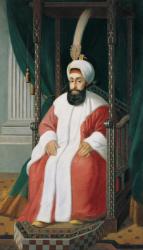
Abdul-Hamid I was the 27th sultan of the Ottoman Empire, born to Sultan Ahmed III. He ascended to the throne on January 21, 1774, succeeding his brother Mustafa III. His mother, Rabia, took care of his education, where he studied history and calligraphy. Abdul-Hamid spent 43 years of his life in prison under the reign of his brother Mustafa. This social isolation allowed his advisors to easily manage state affairs, from which he tried to distance himself. Abdul was a deeply religious person and opposed any wars. However, he inherited the war with Russia (1768-1774) from his brother, which he eventually had to sign the Treaty of Kuchuk-Kainarji (1774), granting Russia the right to have a military fleet in the Black Sea and extend its influence over non-Muslim subjects of the Ottoman Empire in the Balkans and Crimea.
Efforts for Reform
Abdul-Hamid I was one of the most successful "traditionalist" Ottoman reformers since Murad IV (ruled 1623-1640), aiming to revive the empire by restoring its ancient institutions while creating new types of troops and equipping the army with modern weapons. When he came to power and the army asked for assistance, the Sultan replied, "There are no more subsidies in our treasury; the sons of soldiers must study." He also began to restore the military system and established modern schools. Abdul sought to modernize the janissary corps and the navy.
His grand vizier, Halil Hamid Pasha, fought against nepotism and corruption in government institutions and brought provincial rulers to submission. Under the guidance of Admiral Gazi Hasan Pasha, modern ships were built, and many Ottoman sailors and officers were trained in the latest European naval operations. With the help of Baron de Tott, a European serving in the Ottoman Empire, European-style artillery corps were created, and old mine and sapper units were reorganized. Higher schools for engineering, mathematics, and fortification were opened to train Ottoman officers, with military instructors from Europe. France supported this course and sent a large number of specialists in the hope that the revival of Ottoman power would halt Russian expansion in the Black and Mediterranean Seas. However, in 1785, Halil Hamid Pasha was removed from power and executed, as courtiers made Abdul-Hamid believe that he was conspiring to overthrow him and put Prince Selim on the throne. In 1787, the Russians persuaded the French to withdraw their assistance and recall their specialists, after which the reforms significantly slowed down. Nevertheless, a group of people, including Prince Selim (his successor Selim III), who were educated in the new spirit, remained after Abdul-Hamid. It was these individuals who began to implement the necessary reforms.
Challenges and Legacy
Minor military successes against Syria and Morea could not compensate for the loss of Crimea. Relations between the Ottoman Empire and Russia continued to deteriorate; Russia instigated rebellions among Balkan subjects, which contradicted the Treaty of Kuchuk-Kainarji. By that time, most Arab provinces had gained autonomy and were governed by local rulers who refused to pay taxes to the central treasury. Admiral Gazi Hasan Pasha carried out a successful expedition to suppress the uprising in Egypt (1786-1787), but a new war with Russia (1787-1792) forced him to return to Istanbul without fully suppressing the rebels. In 1787, the Russian Empire declared war again, and the following year, Austria and Sweden joined. The ensuing devastating war left no trace of the reforms carried out by Abdul-Hamid. The war ended during the reign of his successor, Selim III, who continued the movement towards reforms.
In 1788, Ochakov was captured by the Russians. Sultan Abdul-Hamid I died four months later at the age of 64 on April 7, 1789. Despite all his political failures, Sultan Abdul-Hamid is considered the kindest of all Turkish rulers. He personally led the fire suppression efforts in Istanbul in 1782 when the city was engulfed in flames, earning admiration from the people. He was so religiously devout that he was nicknamed "the Saint."