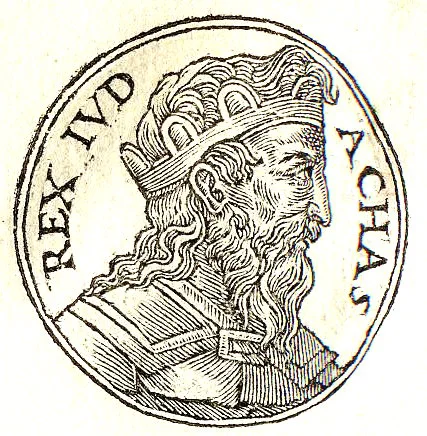
Ahaz
Ahaz ruled the Kingdom of Judah during the eighth century BCE, in an era when the small states of the Levant faced the expanding Assyrian Empire. The biblical books of Kings, Chronicles, and Isaiah remember him chiefly for a fateful choice: when threatened by neighboring rulers, he sought Assyrian protection, drawing Judah into the orbit of a far greater power.
A Kingdom Under Pressure
Ahaz was the son and successor of Jotham and the father of Hezekiah. Dates for his reign are debated because the biblical chronologies do not align neatly; many modern reconstructions place his rule around 735–715 BCE, with some difference over when his sole reign began. The account in 2 Kings says that Rezin of Aram-Damascus and Pekah of Israel attacked Judah and threatened Jerusalem in the conflict often called the Syro-Ephraimite War.
Isaiah’s account presents the prophet urging Ahaz not to panic or depend on a political alliance, and offering a sign of reassurance. Ahaz instead appealed to Tiglath-Pileser III of Assyria, presenting himself as the Assyrian king’s servant and sending silver and gold from the royal and Temple treasuries. Assyrian records independently list a ruler of Judah named Jehoahaz among those who paid tribute, supporting the historical setting of Judah’s submission.
Protection at a Price
Assyria’s campaigns broke the power of Aram-Damascus and weakened the northern kingdom of Israel, relieving pressure on Judah. But the alliance made Ahaz a vassal of the empire. In 732 BCE, Damascus fell to Assyria. Judah gained a powerful protector, while surrendering some independence and wealth to sustain the relationship.
The biblical narrative also describes Ahaz visiting Damascus, seeing an altar there, and ordering a similar altar for the Temple in Jerusalem. It reports that he altered Temple furnishings and made offerings at local shrines. Kings and Chronicles judge these actions harshly, interpreting them as religious disloyalty. Chronicles further accuses him of sacrificing his children, a charge that belongs to the biblical account and should be presented as such rather than as independently verified fact.
A Contested Reputation
The Bible’s portrait of Ahaz is shaped by the theological concerns of its authors. Kings and Chronicles contrast him with David and with his son Hezekiah, who is portrayed as a reformer. Isaiah’s criticism focuses on the political and spiritual consequences of trusting Assyria. Yet from the perspective of a ruler facing an immediate military crisis, appealing to the region’s strongest power may have seemed a means of preserving Jerusalem and the kingdom.
Ahaz died after a reign that secured Judah’s short-term survival but left it under Assyrian dominance. Hezekiah succeeded him and later challenged that dominance, bringing another Assyrian confrontation. Ahaz remains a pivotal figure in biblical history: his decision links Judah’s internal religious debates to the wider imperial politics of the ancient Near East, and the different biblical accounts reveal how strongly his legacy was disputed.





