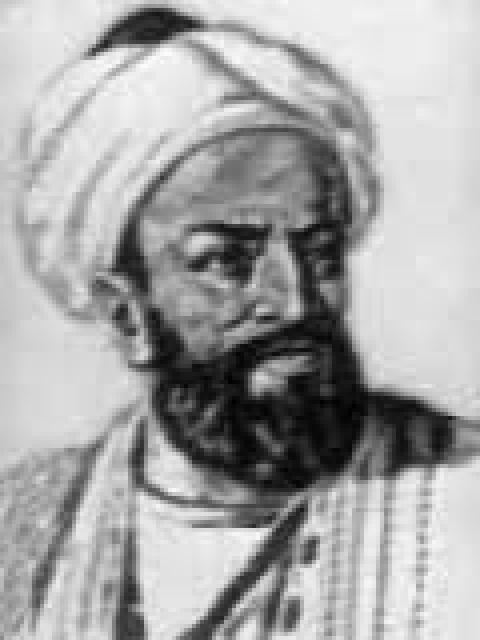
Al-Abbas Al-Jawhari
- Al-Farghani, the Mathematician and Astronomer
- Service at the "House of Wisdom"
- Measurement of the Earth's Meridian
- Euclid's Elements and Theory of Proportions
- Fifth Postulate of Euclid
Al-Farghani, the Mathematician and Astronomer
Al-Farghani was a renowned mathematician and astronomer born in Farab, present-day Southern Kazakhstan.
Service at the "House of Wisdom"
Al-Farghani played a significant role at the "House of Wisdom" in Baghdad, where he collaborated with illustrious scholars like al-Khwarizmi. Alongside Yaḥyā ibn Abū Manṣūr, al-Marwarrudhi, and Sanad ibn Ali, he participated in prominent astronomical observations in Baghdad (830) and Damascus (833). These observations culminated in the compilation of the astronomical work, "Zij al-Ma'mun, Revised."
Measurement of the Earth's Meridian
In collaboration with the same astronomers, Al-Farghani was instrumental in measuring the length of one degree of the Earth's meridian on the Sinjar Plain.
Euclid's Elements and Theory of Proportions
Al-Farghani authored commentaries on Euclid's "Elements," proposing a novel approach to proportion theory. He sought to establish proportions based on the equality of incomplete quotients derived from applying Euclid's algorithm to both ratios.
Fifth Postulate of Euclid
Al-Farghani attempted to prove Euclid's Fifth Postulate, as recorded by Nasir ad-Din al-Tusi. His proof relied on the implicit assumption that if three intersecting straight lines produce equal opposite angles, the same holds for any straight line intersecting the same lines. In the process of proving the Fifth Postulate, Al-Farghani demonstrated the theorem that any line passing through a point within an angle intersects both sides of the angle. This assertion formed the basis of Adrien-Marie Legendre's proof in 1800.