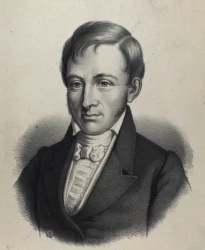
Al-Jahiz
Al-Jahiz turned the bustle of Abbasid life into literature: its scholars arguing over ideas, its officials performing status, its misers guarding their coins, and its readers eager for a clever turn of phrase. A theologian as well as a master of prose, he wrote about animals, rhetoric, politics, human behavior and social life. His work is still admired for combining close observation with humor, intellectual curiosity and a delight in digression.
From Basra to the Abbasid Court
Abu Uthman Amr ibn Bahr, known as al-Jahiz, was born in Basra around 776. His sobriquet is usually translated as “the pop-eyed,” a reference to his prominent eyes. He came from a modest family; later accounts suggest that his father may have been of East African ancestry, though details of his childhood are limited. Stories say that in his youth he sold fish and paid booksellers for the chance to read through the night. Whether or not every anecdote is exact, they fit the image of a determined reader formed in the lively intellectual circles of Basra.
He studied language and literature with leading scholars and joined the debates of Muʿtazili theologians, a rationalist movement within Islamic thought. His writings on the imamate, or religious and political leadership, attracted the attention of the Abbasid caliph al-Maʾmun. Al-Jahiz later worked in Baghdad and Samarra, where he found patrons among senior officials and judges. The Abbasid court offered him access to powerful readers and sponsors, but it also placed his writing amid the political and theological controversies of the day.
A Prose Style of His Own
Al-Jahiz wrote with a range few authors could match. His al-Bayan wa al-tabyin, often translated as “Clarity and Clarification,” explores eloquence, language and the art of persuasion. The Book of Animals, or Kitab al-Hayawan, uses animals as a starting point for a sprawling collection of observations, poetry, anecdotes and reflections on religion, science and human nature. It is not a modern zoology textbook; its appeal lies in the way al-Jahiz turns natural history into a lively conversation about the world.
His best-known work for many general readers is the Book of Misers, a comic gallery of people whose thrift becomes an art form. In its tales, stinginess produces elaborate excuses, improvised schemes and small social dramas. Some characters may be based on real people, while others are likely invented or reshaped for comic effect. The result is both entertaining and revealing: al-Jahiz uses the miser’s habits to explore hospitality, class, reputation and the unspoken rules of everyday life.
The range of his writing also extended to serious theological and political questions. He defended Muʿtazili positions during the period when Abbasid rulers supported the doctrine that the Qur’an was created, and he wrote polemics against religious opponents. At the same time, his essays often resist a single simple interpretation. He quotes at length, stages arguments from opposing sides and uses wit to test what readers think they know.
Later Years and Legacy
Al-Jahiz returned to Basra in later life, reportedly suffering from partial paralysis. He died there in 868 or 869. A famous legend says that a collapsing pile of books killed him, an ending perfectly suited to his reputation as a man surrounded by reading and writing. Other accounts describe his death as the result of a stroke.
Medieval readers came to treat his name as a byword for eloquent Arabic prose. Nearly two centuries after his death, his books continued to be read for pleasure and instruction. His legacy endures because he made learning feel social and alive: in his hands, an argument could become a joke, an animal could open a debate about creation, and a miser’s excuse could illuminate an entire society.