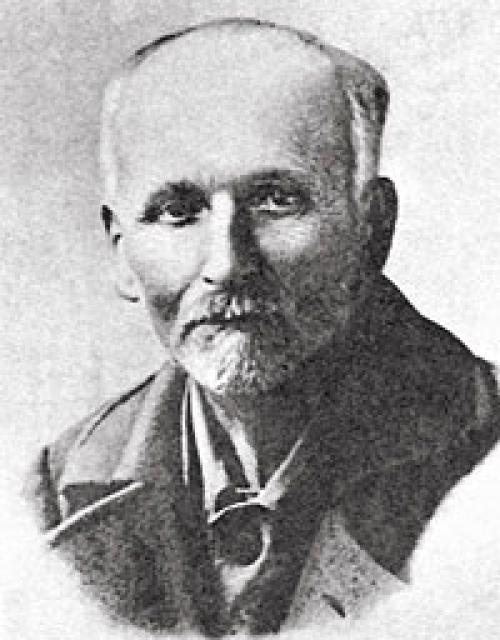
Alexander Dobrolubov
 Russia
Alexander Dobrolyubov: A Biography
Alexander Dobrolyubov was a Russian poet and truth-seeker who played a significant role in the history of Russia. His life can be characterized by the epigraph of his own quatrain: "The colors of the sunset are more vibrant than the sunrise, And our sacrifice is not for others, but for ourselves! Our freedom may be bondage, But we die, loving something madly." Dobrolyubov was precise in the uncertainty of this "something." This was the essence of Russian truth-seeking, which was purer and more untarnished the more indefinite it was.
Unlike his contemporary Nikolai Minsky, who was a mediocre poet at best but still had some notable works, Alexander Dobrolyubov was not considered a remarkable poet. He lacked the certainty in choosing the right words, was careless with rhymes, and, to put it bluntly, indulged in literary excess. His poetry would not have been included in any anthology of poetic works if it wasn't for his poem "Did I Wake up at Night? Did I Wake up in the Morning?.." In this poem, the styles of two psychologically dissimilar poets, Gavriil Derzhavin and Velimir Khlebnikov, unexpectedly and naturally converge. This poem, although not genius in itself, demonstrated Dobrolyubov's potential as a poet.
Dmitry Merezhkovsky, a renowned Russian writer, once described a conversation with Dobrolyubov, stating, "I had no doubt that I was in the presence of a saint. It seemed as if a golden halo was about to appear above his bowed head, reminiscent of Fra Angelico's paintings. Indeed, between these two figures—St. Francis of Assisi and Alexander Dobrolyubov—who stands third after five centuries of Christianity? One is glorified, the other remains unknown, but what difference does it make before God?"
Family plays a crucial role in shaping an individual's personality. And Dobrolyubov's family was exceptional. They dedicated their lives not to themselves but to the entire human family, extending their help beyond the walls of their home. Dobrolyubov's father achieved a rank equivalent to a general and was a state councilor. He played a significant role in the creation of the Peasant Land Bank. Despite his early demise, he left a substantial inheritance to his orphaned family. However, all eight children chose paths different from their father's.
Dobrolyubov's beloved sister, Masha, who resembled Murillo's Madonna, graduated from the Smolny Institute and worked tirelessly, organizing a school for the poor in St. Petersburg. During the Russo-Japanese War, she gained fame as a nurse for not only helping her compatriots but also saving the life of a wounded Japanese officer. Upon her return to St. Petersburg, she joined the Socialist Revolutionary Party. On December 31, 1911, Alexander Blok wrote in his diary, "The leaders of the revolution listened to her unquestioningly; had she been different, the course of the Russian revolution could have been different." Rumor has it that she was sent on a terrorist mission, but her firsthand experience of the bloodshed on the battlefields prevented her from committing murder. In anticipation of accusations of cowardice, she took poison. Dobrolyubov, influenced by the writings of Wilde and Huysmans, experienced a different kind of poison—from hashish to decadence and a cult of death, which even scared Valery Bryusov. According to his friend Vladimir Gippius, Dobrolyubov dressed like a black version of a hussar, covering the walls of his apartment with mourning paper. Sergei Makovsky recounts how the Petersburg high school students amused themselves with Dobrolyubov's exaggerated pessimism. They held a mocking "tribute" in the form of a parody ball of the living dead. When Dobrolyubov, who initially took it all seriously, learned that he had simply become an object of laughter, he was deeply offended. There is nothing more offensive to a person than realizing they are being ridiculed in the eyes of others.
After leaving the university, Dobrolyubov suddenly embraced a life of complete renunciation. He divided his wealth among his friends and embarked on a journey through the Belozersk region. Boris Pasternak, who undoubtedly saw the flaws in Dobrolyubov's poetry, noted in a letter to V. Veresaev on May 20, 1939, the exceptional spiritual tenacity of this poet: "...the spiritual essence of Dobrolyubov's verses is not a casual quality but an essential aspect of their structure and impact. They touch upon poetry as a phenomenon of the spirit, not directly, as is the case with its immediate creations."
Dobrolyubov was often questioned about his refusal to obtain a passport. He answered with a line from his adaptation of Jesus Christ's sermon: "Blessed are those who are persecuted, for theirs is the kingdom of heaven." He believed that a future was near when passports would be abolished worldwide because there would be no borders.
He foresaw the emergence of a pseudo-elite, which we now call the nomenklatura, in the early 1930s in his poem "The Soviet Nobleman." Despite the rhetoric of "caring for the people," this pseudo-elite received additional privileges, such as tax-free benefits exceeding their official salaries, and had access to special distributors. This pseudo-nobility, devoid of the cultural upbringing of the lyceum generations, imposed their plebeian tastes everywhere, including the realm of art.
Dobrolyubov resurrected the nobleman.
He rises again
In infinitely different disguises.
His goal is so simple – elevation and rank…
All efforts are always crudely flat.
The entire color palette – millions of masks.
The foundation is rough, without a dent.
No longer by birth, but by bourgeois intellect…
Do you recognize your namesake, all ancient ones?