Alexander I Battenberg
 Italy
Italy- Early Life and Military Career
- Election as Prince of Bulgaria
- Arrival in Bulgaria and Formation of Government
- Political Instability and Dissolution of the Assembly
- Opposition and Conservative Government
- Appointment of Dragan Tsankov
Early Life and Military Career
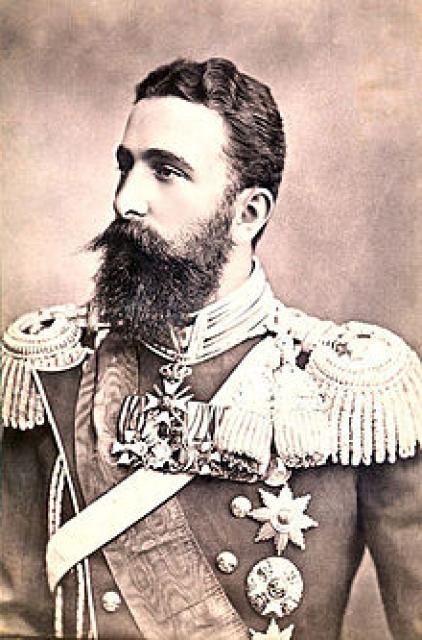
Alexander I of Battenberg, the first Prince of Bulgaria from the German Battenberg dynasty, was born on April 15 (27), 1880. He was the second son of Prince Alexander of Hesse-Darmstadt and Countess Julia von Hauke, who received the title of von Battenberg in 1858. As a young man, Alexander spent much time in St. Petersburg, where he was close to his aunt, Empress Maria Alexandrovna, the wife of Alexander II. At the outbreak of the Russo-Turkish War, he accompanied his uncle on campaign and was awarded the Order of St. George, 4th degree, for his bravery.
Election as Prince of Bulgaria
Following the war, Emperor Alexander II of Russia proposed the candidacy of his grand-nephew for the newly established Bulgarian throne. On June 26, 1879, Alexander was elected Prince of Bulgaria by the Grand National Assembly. His election was recognized by all the Great Powers signatory to the Treaty of Berlin.
Arrival in Bulgaria and Formation of Government
Upon his arrival in Bulgaria, Alexander appointed Todor Burmov as the first Prime Minister. The government was dominated by liberals, including Marko Balabanov, Grigor Nachevich, and Dimitar Grekov. Russian General Parsenov took charge of the War Ministry. Although initially popular, Alexander began to lose support due to his perceived favoritism and his inability to navigate the complexities of Bulgarian politics and foreign interference.
Political Instability and Dissolution of the Assembly
The elections held in 1879 resulted in a majority for the opposition, led by Dragan Tsankov and P. Karavelov. Despite Alexander's reluctance, the Assembly expressed its disapproval of the government, and it was subsequently dissolved by princely decree on November 3, 1879. A new cabinet was formed, led by Minister of the Interior Ikonov and Metropolitan Clement of Tarnovo, but the de facto leader was Nachevich, who controlled the Ministries of Finance and Foreign Affairs.
Opposition and Conservative Government
Alexander's close association with a small circle of advisors, including Grekov and Stoilov, further alienated the opposition, which had the support of the press and school teachers. The government's dismissal of civil servants in 1880 further inflamed tensions with the opposition. New elections in 1880 resulted in a setback for the government, and it resigned in April.
Appointment of Dragan Tsankov
On the advice of the Russian emperor, Alexander entrusted Dragan Tsankov, a respected figure in Bulgarian politics, with forming the new government. Tsankov was tasked with restoring stability and addressing the growing political divisions in the country.