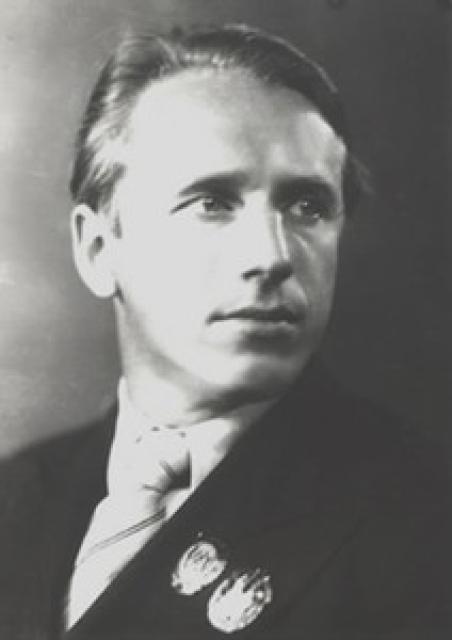
Alexey Ermolaev
- Early Life and Dance Training
- Career as a Soloist and Principal Dancer
- Innovation in Male Dance
- Virtuosity and Characterization
- Retirement and Teaching
- Pedagogical Legacy
- Impact on Dance Education
- Legacy and Death
Early Life and Dance Training
Alexei Nikolaevich Yermolayev was born on February 10 (23), 1910, to a peasant family in the Tver Governorate (or St. Petersburg, according to some sources). From 1920, he studied at A.L. Volinsky's ballet school in Petrograd under the tutelage of N.G. Legat. From 1921 to 1926, he attended the Petrograd Choreographic School, where he completed the entire school program in six years with V.I. Ponomarev.
Career as a Soloist and Principal Dancer
In 1926, Yermolayev joined the ballet troupe of the Leningrad State Academic Opera and Ballet Theatre (LATOB) as a soloist. In 1930, he was invited to the Bolshoi Theatre in Moscow, where he remained until the end of his career.
Innovation in Male Dance
Yermolayev's name is associated with the creation of a new direction in male dance. He responded to the general trend of heroicizing ballet, emphasizing its dramatic and playful components, and incorporating elements of folk dance into classical ballet technique.
Virtuosity and Characterization
Yermolayev possessed exceptional technical skill, which he constantly refined and extended. In his diverse roles, he established a courageous and determined image in ballet. Renowned choreographers such as V.I. Vainonen and L.M. Lavrovsky supported his approach, which earned him a Stalin Prize in 1946.
Retirement and Teaching
Despite pushing the boundaries of dance technique, Yermolayev's career was curtailed by a serious injury. From 1939 onward, he focused on roles that required dramatic expression and pantomime.
Pedagogical Legacy
From 1960 until his death, Yermolayev worked as a teacher and ballet master-repetiteur at the Bolshoi Theatre. He mentored rising ballet stars such as Maris Liepa, Mikhail Lavrovsky, Vladimir Vasiliev, Alexander Godunov, and Boris Akimov.
Impact on Dance Education
Concurrently with his work at the Bolshoi, Yermolayev also taught at the Moscow Choreographic School. From 1960 to 1972, he served as a classical dance teacher, and from 1968 to 1972, he was artistic director. Among his pupils were Y.K. Vladimirov, V.S. Lagunov, S.N. Radchenko, and Y.Y. Vetrov.
Legacy and Death
Yermolayev died in Moscow on December 12, 1975, and was buried at the Vvedenskoye Cemetery. His innovative approach in male dance and his influence as a teacher continue to shape ballet education and performance.


