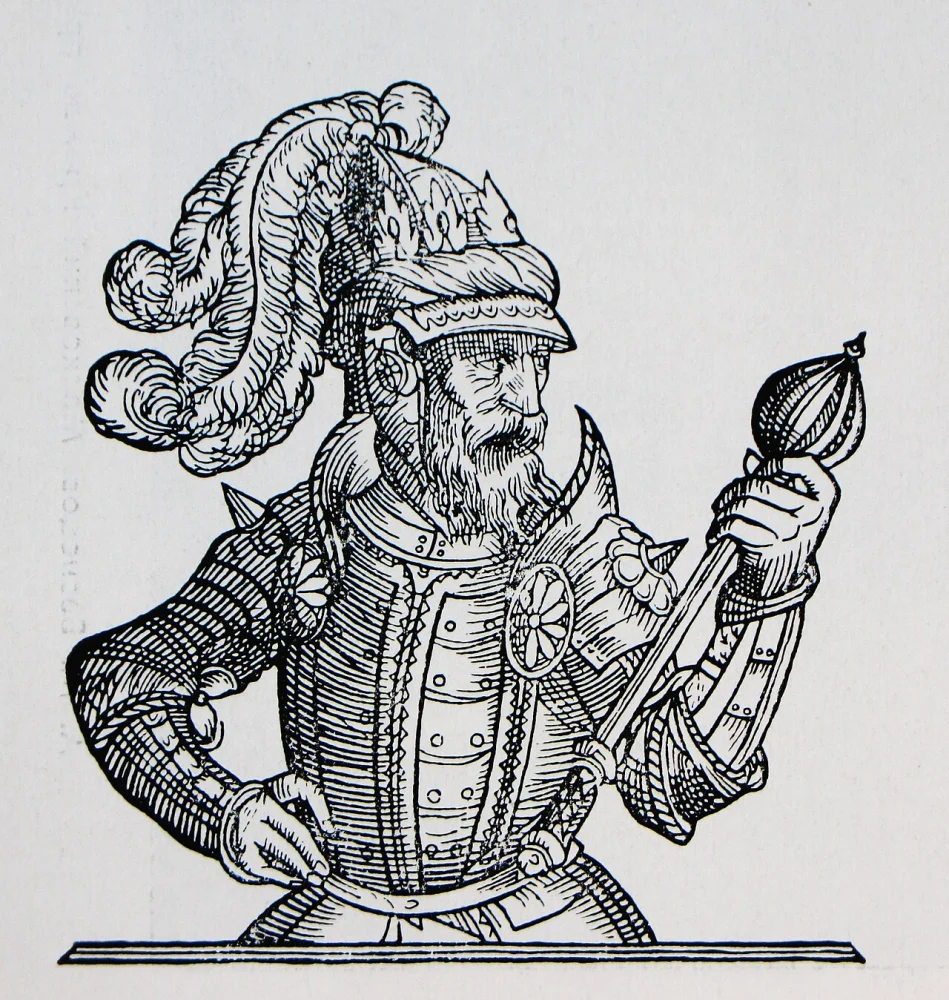
Algirdas
Algirdas transformed the Grand Duchy of Lithuania into one of the most powerful states in medieval Europe. Ruling from 1345 to 1377 alongside his brother Kęstutis, he expanded Lithuanian influence deep into the eastern Slavic lands while resisting pressure from the Teutonic Order in the west. His reign was marked by military ambition, careful partnerships, and a realm built from peoples of different faiths and languages.
Origins and Rise to Power
Born around 1296, Algirdas was a son of Grand Duke Gediminas, founder of the dynasty that would shape Lithuania for generations. Before becoming grand duke, he ruled Kreva and, through his marriage to Maria, the principality of Vitebsk. That territory was later incorporated into the Grand Duchy.
In 1345, Algirdas and his brother Kęstutis joined forces to depose their younger brother Jaunutis, then grand duke. Their agreement divided responsibilities: Algirdas directed much of the state’s eastern policy, while Kęstutis concentrated on relations with Poland and Hungary and the defense of the western frontier. The partnership proved durable and helped Lithuania coordinate its response to threats on several fronts.
Expansion and Conflict
The Teutonic Order remained a persistent danger. Algirdas and Kęstutis repelled major attacks, but the war was not one-sided: Lithuanian forces also raided territories held by the Order. In 1362, Teutonic forces destroyed Kaunas Castle, and raids reached Trakai and Vilnius in the final years of Algirdas’s reign. The sustained pressure made the defense of Lithuania a defining part of his rule.
Algirdas also extended Lithuanian authority east and south. His campaigns and alliances strengthened the duchy’s position in lands that include parts of present-day Belarus and Ukraine, including Kyiv and Podolia. The events remembered as the Battle of Blue Waters are often described as a sweeping victory over the Golden Horde. Yet the earliest surviving chronicle account is brief and does not clearly describe a battle against the Tatars; historians have questioned how later chronicles shaped that story. What is clearer is that Algirdas consolidated Lithuanian power in the region during the Golden Horde’s period of internal upheaval.
His rivalry with Moscow produced three campaigns, in 1368, 1370, and 1372. Algirdas supported his brother-in-law Mikhail of Tver in the struggle for influence among the Rus’ principalities, but the Lithuanian forces failed to take Moscow. A settlement in 1372 ended the immediate conflict. The contest revealed both the reach of Algirdas’s power and its limits: Lithuania could challenge Moscow, but could not displace it as the dominant center of the northeastern Rus’ lands.
Faith, Family, and Government
Algirdas maintained a complex religious policy. Lithuania remained predominantly pagan, while many of the eastern lands under its rule were Orthodox Christian. He negotiated with Western envoys about Lithuania’s possible conversion and also corresponded with the patriarch of Constantinople over Orthodox church organization. No conversion followed, and Algirdas remained faithful to the religion of his ancestors.
He married twice: first Maria of Vitebsk and, around 1350, Juliana of Tver. Their children included future grand dukes Jogaila, Skirgaila, and Švitrigaila. Rather than replacing local elites across the enlarged realm, Algirdas often entrusted territories to regional princes or members of his own family, helping secure loyalty while preserving a varied political landscape.
Final Years and Legacy
Algirdas died in May 1377. According to Lithuanian historical tradition, his body was cremated in keeping with the old customs of his people. His death was followed by dynastic struggles, but the state he had strengthened remained a major power in eastern Europe. His reign stands out for joining military expansion with practical governance across a diverse realm, even as his failed campaigns against Moscow showed that Lithuania’s ambitions had real limits.