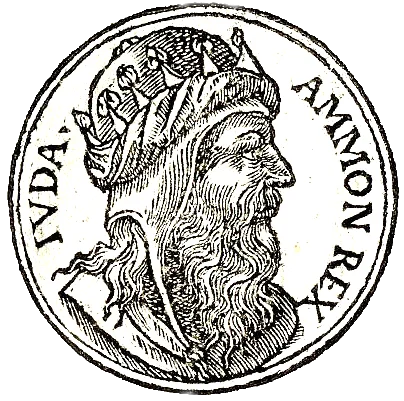
Amon
Amon was a king of Judah who ruled briefly from Jerusalem in the seventh century BCE. He is remembered chiefly because his assassination ended the long reign of his father, Manasseh, and brought his young son Josiah to the throne. The surviving accounts offer only a short portrait, so the details of Amon’s government and personal life remain largely unknown.
A Short Reign in Jerusalem
The biblical books of Kings and Chronicles identify Amon as the son of Manasseh and his successor as king. According to 2 Kings, he was twenty-two years old when he began to rule and reigned for two years. His mother was Meshullemeth, daughter of Haruz of Jotbah. The chronology is usually placed around 642–640 BCE, although ancient regnal dates can vary among modern reconstructions.
Amon inherited the throne during a period when Judah remained within the political orbit of the Assyrian Empire. The biblical record does not describe his foreign policy, military campaigns, or administrative work in detail. It instead evaluates his reign through religious conduct. Kings portrays him as following the religious practices of his father and condemns his worship of other gods. This is the perspective of the biblical narrators, who assess Judah’s rulers according to their devotion to the worship of the God of Israel.
Assassination and Succession
The accounts agree that Amon was killed by members of his own court. The conspirators assassinated him in his palace, but the people of the land then killed those responsible and placed his eight-year-old son Josiah on the throne. The texts give no clear explanation for the plot or the motives behind it. Whether the killing reflected factional disputes, resistance to Amon’s policies, or personal conflict cannot be established from the evidence that survives.
Amon was buried in the garden of Uzza, the royal burial place also associated with Manasseh. His son Josiah would later become one of Judah’s most consequential kings, remembered for a major religious reform. The contrast between Josiah’s long reign and Amon’s brief one makes the transition particularly striking, but the sources do not tell us what Amon thought of his heir or what plans he may have had for the kingdom.
Historical Limits and Legacy
No detailed contemporary record of Amon’s reign has been securely identified outside the biblical narrative. The biblical writers say that further acts of his rule were recorded in the annals of the kings of Judah, but that document has not survived. As a result, historians must distinguish the limited dynastic information—his father, son, age, short reign, and assassination—from the religious judgment supplied by the texts.
Amon’s historical significance lies chiefly in the abrupt end of his rule and its consequences. His death brought Josiah to power while still a child and opened a new chapter in Judah’s history. Beyond that succession, the king remains an obscure figure whose brief appearance in the records leaves more questions than answers.