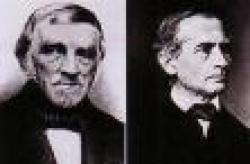
Andrew Douglas
 USA
USA- Andrew Ellicott Douglas: American Astronomer and Archaeologist
- The Discovery of Climate Influence
- Biography
Andrew Ellicott Douglas: American Astronomer and Archaeologist
Andrew Ellicott Douglas was an American astronomer and archaeologist, and the founder of dendrochronology. He discovered the correlation between tree rings and solar cycles. Craters on the Moon and Mars are named in his honor. In a sense, Douglas was able to peer into the past by studying logs from old buildings, as well as sequoias and other long-lived trees.
The Discovery of Climate Influence
Douglas noticed that tree rings became thinner in dry years, leading him to identify the climatic influence of solar variations and the lack of solar activity in the 17th century. British astronomer William Herschel and his colleagues failed to notice this. However, other scientists had reasons to doubt that tree rings could show anything beyond random regional differences. The significance of studying tree rings for climate research was underestimated until the 1960s. Douglas became the founder of dendrochronology, a method of dating wooden objects by studying the characteristics of tree rings. He began his research in this field in 1894 while working at the Lowell Observatory.
Biography
Andrew Ellicott Douglas was born on July 5, 1867, in Windsor, Vermont. He attended Trinity College in Hartford, Connecticut, and graduated with honors in 1889. He then started working at the Harvard Observatory. Douglas served as the chief assistant during the Boyden expedition from 1891 to 1893, which led to the establishment of the Harvard Observatory in Arequipa, Peru. After returning from Peru, Douglas met Percival Lowell in Boston, who hired him to explore Arizona and find the best location for an observatory. In 1894, Douglas traveled through Arizona and eventually selected Flagstaff as the ideal city. He supervised the construction of a dome and installed an 18-inch telescope for observing Mars. Douglas and Lowell used this telescope to observe the planet. It was rumored that towards the end of his life, Douglas admitted choosing Flagstaff because of its excellent saloons.
After the completion of Lowell Observatory in 1894, Douglas worked as Lowell's chief assistant for seven years, collecting a vast amount of data on Mars. Lowell used this data to support his theory of a Martian civilization capable of constructing artificial canals. However, Douglas insisted that Lowell selectively used the data to prove his theory, which he believed was unscientific and inaccurate. In 1901, Lowell grew impatient and fired Douglas. From 1901 to 1906, Douglas remained in Flagstaff, teaching Spanish language, Spanish history, and geography at the Northern Arizona Normal School, now known as Northern Arizona University. In 1902, he even served as a justice of the peace. It was during his time in Flagstaff that Douglas became interested in studying tree rings and their connection to solar cycles.
In 1906, Douglas moved to Tucson and joined the University of Arizona as a professor. His most significant scientific achievement at this time was the establishment of dendrochronology, a discipline that uses tree rings to determine the age of wooden objects. He created a continuous sequence of tree rings from the yellow pine, which stretched back so far that in 1929, he was able to determine the age of ancient Native American structures. This achievement was hailed as one of the most important archaeological discoveries. During his time at the University of Arizona, Douglas continued to actively pursue astronomy. In 1916, he met Lavinia Steward and her husband, who were interested in astronomy. When Mr. Steward passed away, Mrs. Steward donated $60,000 to the University of Arizona for the construction of an observatory. The Steward Observatory was completed in 1923 and equipped with a 36-inch reflecting telescope. The observatory later relocated to Kitt Peak, where it continues its operations. Douglas served as the director of the observatory until his retirement in 1937, after which he devoted all his energy to the study of dendrochronology, establishing the Laboratory of Tree-Ring Research at the University of Arizona.
Douglas remained active until two years before his death when illness left him disabled. He passed away on March 20, 1962, at the age of 94.