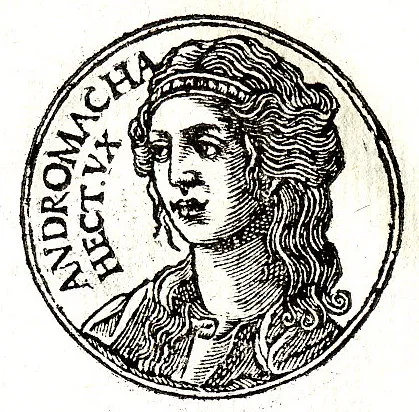
Andromache
Andromache is remembered as one of the most moving figures in the Trojan War stories: a loving wife and mother whose private world is repeatedly shattered by war. In Homer’s Iliad, her farewell to Hector and their infant son gives the epic one of its most intimate scenes. Later poets follow her from the fall of Troy into captivity and an uncertain new life among her conquerors.
Family and the war
Andromache was the daughter of Eëtion, ruler of Thebe in the Troad, and the wife of Hector, Troy’s greatest defender. Before the events of the Iliad, Achilles killed her father and seven brothers. Her mother was captured and later ransomed, but also died, leaving Hector and their young son Astyanax as the family she cherished.
In Book 6 of the Iliad, Andromache meets Hector near Troy’s gates and begs him not to return to battle. She urges him to defend the city from its walls, telling him that she has lost everyone else. Hector knows the Trojans are likely to fall, but feels bound to fight. Their baby is frightened by Hector’s helmet, and the parents share a brief, tender moment before he returns to the battlefield.
The fall of Troy
When Achilles kills Hector, Andromache’s fear becomes reality. The Iliad depicts her grief and the mourning of the Trojan women. Later accounts tell of the city’s capture and the killing of Astyanax by the Greeks. Andromache is taken as a captive by Neoptolemus, Achilles’ son, and carried away from Troy.
The Greek tragedies made her captivity a new stage of her story. In Euripides’ Trojan Women, she leaves the ruined city with her child and faces separation from him as the victors decide the captives’ fates. Euripides’ Andromache is set later, in Phthia: there she is a captive and concubine of Neoptolemus, who is married to Hermione. A son born to Andromache becomes the focus of Hermione’s jealousy and a struggle for survival.
Life after captivity
Ancient writers tell different versions of Andromache’s later life. In one tradition, after Neoptolemus dies, she marries the Trojan seer Helenus, Hector’s brother, and lives with him in Epirus. Some accounts give them a son, Cestrinus. After Helenus’ death, Andromache is said to have gone to Asia Minor with her son Pergamus, who founded the city of Pergamum.
These stories transform the once-royal Trojan wife into a survivor who endures successive losses and changes of home. Their differing details reflect the many poets and communities that reshaped her legend over time.
Enduring image
Andromache’s most enduring scene remains the farewell at Troy’s gates: a family trying to hold on to tenderness as war presses in. Homer presents her as loving and clear-eyed about the dangers ahead, while later tragedy gives her voice to the suffering of women made captive by conquest. Through these works, she became a lasting emblem of grief, loyalty, and endurance.