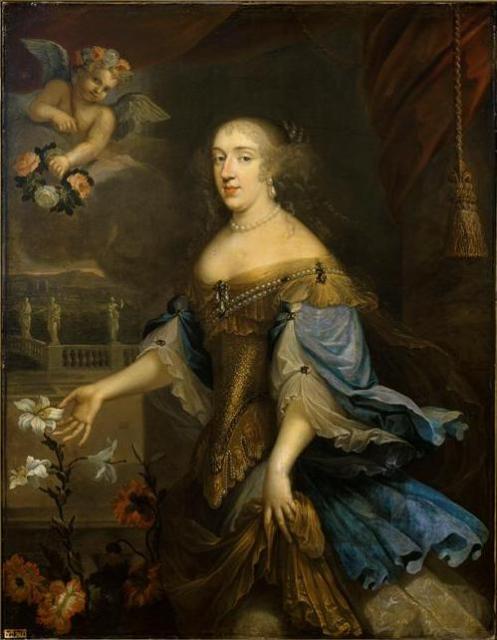
Anne Montpensier
 France
- Anne Marie Louise d'Orléans, Duchess of Montpensier
- Personal Life
- Fronde and Exile
- Return and Marriage
- Later Years
- Memoirs
- Titles
Anne Marie Louise d'Orléans, Duchess of Montpensier
Early LifeBorn on May 29, 1627, in the Louvre Palace, Anne Marie Louise d'Orléans was a princess of the French royal blood, a niece of Louis XIII, and the daughter of Gaston, Duke of Orléans (Monsieur), and Marie de Bourbon, Duchess of Montpensier. Anne's mother, who was an heiress to a vast fortune and numerous titles, died shortly after her birth, leaving the infant Anne to be raised at the court of Louis XIII under the care of the queen, Anne of Austria.
Personal Life
As a princess of the blood and heiress to her mother's wealth, Anne was considered a highly desirable marriage prospect. Among her early suitors was the Prince of Wales (later King Charles II of England), but Anne deemed the exiled prince an unworthy match. In 1646, she harbored hopes of becoming Empress by marrying Emperor Ferdinand III, but her plans were thwarted when he instead chose to wed an Archduchess of Tyrol.
Anne's aspirations for marriage also included her cousin, Louis XIV, who was a decade younger than her. However, their relationship was marred by Anne's involvement in the Fronde, a series of uprisings against the monarchy.
Fronde and Exile
Inspired by her father, Anne sided with the Frondeurs and developed a deep resentment towards Cardinal Mazarin, whom she held responsible for her thwarted marriage. During the armed conflicts in Paris, she played an active role, commanding an army and personally participating in military engagements. In 1652, she rescued the Prince of Condé by firing cannons at royal troops and securing the gates of the city.
When Anne of Austria and Mazarin regained power, Anne, along with other Frondeurs, was banished from Paris and spent years in exile.
Return and Marriage
In 1657, Anne received the king's pardon and returned to the court, but her rebellious past and advancing age deterred potential suitors. In 1670, she surprised everyone by petitioning Louis XIV to allow her marriage to Antoine Nompar de Caumont, the son of a minor count. Though initially reluctant, Louis agreed, fearing that a marriage to a prince would give a potential husband too much influence.
However, Anne's relationship with Caumont was fraught with problems. He was arrested and imprisoned for a decade, and Anne spent years trying to secure his release. Eventually, she gave up some of her territories to the king's illegitimate son in exchange for Caumont's freedom. The couple married secretly in 1681, but their relationship soon deteriorated, and Anne broke off all contact with her husband.
Later Years
Anne lived her final years in the Palais du Luxembourg, where she died on April 3, 1693. She was buried in the Basilica of Saint-Denis, but her tomb was desecrated during the French Revolution. Her heart was preserved in the church of Val-de-Grâce.
Memoirs
In her later years, Anne began writing her memoirs, which were not published until 1729. Despite being self-centered and fragmented, the memoirs provide valuable insights into the personalities and events of the 17th century, particularly the members of the royal family and the participants in the Fronde. Anne's vivid descriptions of Queen Christina of Sweden's attire and the various genres she blends within her memoirs are particularly noteworthy.
Titles
From birth, Anne held the title of Mademoiselle, a designation given to the eldest unmarried daughter of the Duke of Orléans. She inherited numerous titles and territories from her mother, including Duchess of Montpensier, Princess of Dombes, and Dauphine of Auvergne. Her father's title of Monsieur was later supplemented with "Grand" to distinguish him from his nephew, Philippe, Duke of Anjou (Monsieur the Younger). Accordingly, Anne became known as "La Grande Mademoiselle" (The Great Mademoiselle).