Anthemius
- An imperial appointment
- The campaign against the Vandals
- Conflict with Ricimer
- A reign amid imperial collapse
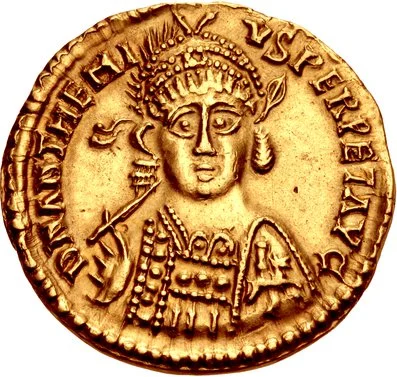
Anthemius became Western Roman emperor at a moment when the empire’s western territories were under pressure from rival kingdoms and the imperial court depended on powerful generals. Backed by the Eastern Roman emperor Leo I, he brought military experience and strong connections to Constantinople to the throne. His reign saw an ambitious campaign against the Vandals fail, while his uneasy alliance with the general Ricimer descended into civil war.
An imperial appointment
Anthemius was born into an influential eastern Roman family in the early fifth century. He served as a military commander and held high offices under the emperors Marcian and Leo I. His marriage connected him to the imperial family: he was the son-in-law of Marcian, and his daughter Alypia later married Ricimer, the powerful western general who had played a leading role in selecting and deposing emperors.
After the death of Emperor Libius Severus in 465, the Western Empire had no effective emperor for nearly two years. In 467, Leo I appointed Anthemius to the western throne. He entered Rome on 12 April and was recognized by the Senate. The appointment was meant to restore stability and coordinate the two halves of the Roman Empire against common enemies. Ricimer accepted the settlement and married Alypia, creating a family bond between the emperor and the man whose military power was essential to his rule.
The campaign against the Vandals
Anthemius’s most ambitious challenge was the Vandal kingdom in North Africa. The Vandals controlled Carthage and much of the western Mediterranean, threatening Roman shipping and the coasts of Italy and Greece. In 468, Leo I organized a large joint expedition, with eastern forces under Basiliscus and western forces commanded by Anthemius’s general Marcellinus. The scale of the operation reflected the importance of reclaiming Africa.
The campaign ended disastrously. Vandal king Gaiseric used fire ships against the Roman fleet near Cape Bon, destroying vessels and undermining the invasion. The defeat cost the empire enormous resources and removed the prospect of a swift reconquest. It also damaged Anthemius’s authority, since the western government had few reserves with which to rebuild its military strength.
In Gaul, Anthemius also tried to resist the Visigoths, who were expanding their territory under King Euric. The Roman commander Riothamus, sometimes described in later tradition as a British king, cooperated with imperial forces, but the campaign failed. Anthemius faced a widening crisis: the empire’s ability to defend its provinces was weakening, while its court remained divided over who should command its remaining armies.
Conflict with Ricimer
Anthemius’s eastern origins and his reliance on imperial support from Constantinople created friction among western elites. His relationship with Ricimer, already a delicate partnership, deteriorated. The general had long been accustomed to wielding the power behind the throne, while Anthemius sought to govern as an emperor in his own right. Political factions in Rome sharpened the disagreement.
In 472, Ricimer raised the senator Olybrius as a rival emperor and besieged Anthemius in Rome. The city was taken after fighting and a destructive siege. Anthemius was captured and killed, traditionally said to have been beheaded by Gundobad, Ricimer’s nephew. Ricimer himself died only weeks later, and Olybrius survived Anthemius by a short time.
A reign amid imperial collapse
Anthemius ruled for five years, but his reign could not reverse the forces fragmenting the Western Roman Empire. The failed Vandal expedition drained resources, the campaign in Gaul did not stop Visigothic expansion, and the rupture with Ricimer turned the capital into a battlefield. His appointment had briefly raised hopes that eastern and western imperial power could cooperate, but that promise proved impossible to sustain.
His death was another episode in the cycle of military strongmen and short-lived emperors that marked the final decades of Roman rule in the West. Anthemius is remembered as an experienced commander and an emperor with ambitious plans, whose fortunes were undone by the military failures and political rivalries he had been appointed to contain.