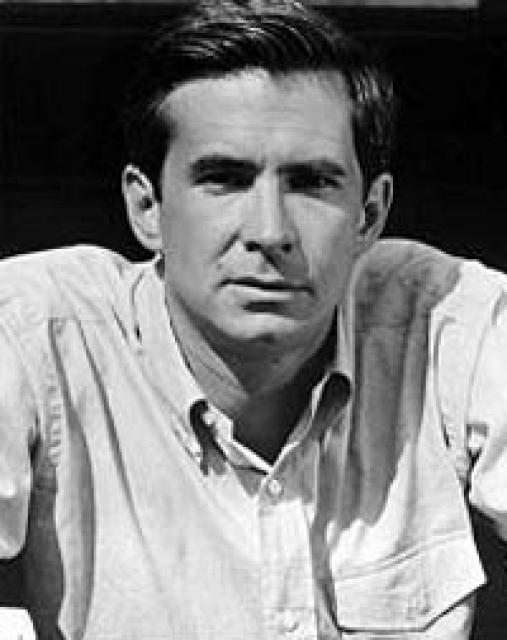
Anthony Perkins
 USA
USAAnthony Perkins: A Shy and Talented Actor
Anthony Perkins was an American actor who stood out in the world of American cinema. In an industry dominated by confident, victorious men, Perkins' characters were often seen as outliers. With his delicate appearance, slender neck, nervous face, and quiet voice, there was something about him that evoked a sense of sympathy and protectiveness from people. They wanted to pity him, to caress him, and to teach him how to stand tall in a ruthless world that preyed on the weak.
Early Career and Recognition
Perkins had an easy start in the film industry, thanks to his father, the renowned actor Osgood Perkins. He mostly worked with "feminine" directors such as George Cukor and William Wyler in his early days, starring in films like "The Actress" (1953) and "Friendly Persuasion" (1956), for which he won a Golden Globe Award for Most Promising Newcomer. His distinctive appearance and character were brilliantly utilized by Anthony Mann in the Western film "The Tin Star" (1957). As Sheriff Ben Owens, a young and inexperienced lawman, Perkins' role was unconventional for the genre. Throughout the film, he not only had to learn how to shoot accurately but also had to grasp the main truth: fighting evil can only be done with clean hands and by avoiding unnecessary violence.
Breakout Roles and International Fame
In Delbert Mann's film "Goodbye Again" (based on the novel by Francoise Sagan) released in 1961, Perkins played Ebin Cabot, a passionate lover. In this love anthem that triumphs over greed, his fiery temperament was evident, especially compared to his previous meek characters. The theme of sacrifice, prominently portrayed in the film's finale when Ebin is willing to share responsibility for a crime he did not commit with his beloved woman, can also be found in Stanley Kramer's movie "On the Beach" (1959). In this film, Perkins played Peter Holmes, the head of a young family who gives lethal pills to his wife and infant son to spare them a painful death before taking one himself.
Transformation in Hitchcock's "Psycho"
Perkins' characters in the 1950s were typically dreamers and romantics, living in a world where there was no place for such people. The only thing they could oppose to the cruelty and chaos surrounding them was their own dignity, sincerity of feelings, and emotional sensitivity. These qualities were equally present in the religious pacifist youth in "Friendly Persuasion," the rugged farmer in "Goodbye Again," and the brilliant lieutenant in "On the Beach." This well-established image was turned upside down by Alfred Hitchcock in one of his best films, "Psycho" (1960). The director skillfully used the contrast between Perkins' intellectual appearance and the pathological passion that possessed his character, Norman Bates. Raised by an ambitious and controlling mother who instilled in him a hatred for women, he developed a split personality and committed a series of murders. The film's climax was particularly striking. When the exposed and captured killer sits huddled in an empty room against a white wall, his voice changes dramatically. Instead of the actor's usual low, velvety voice, the audience hears a thin, piercing, truly feminine voice. This transformation marked Perkins' highest achievement and brought him international fame. He received the Best Actor award at the 14th Cannes Film Festival for his expressive portrayal of a young lover to an aging heroine (Ingrid Bergman) in the screen adaptation of Francoise Sagan's novel "Goodbye Again" ("Goodbye Again," Anatole Litvak, 1961).
Later Career and Personal Life
Perkins played various roles throughout his career, often returning to the psychopathological motif that Hitchcock had introduced. He starred in two sequels to "Psycho": "Psycho II" (1983) directed by Richard Franklin and "Psycho III" (1986), which also marked his directorial debut. However, neither film could compare to Hitchcock's masterpiece. Perkins portrayed Hector MacQueen, the secretary of a criminal, in Sidney Lumet's "Murder on the Orient Express" (1974) based on Agatha Christie's novel. He also played a deranged priest and murderer in Ken Russell's "Crimes of Passion" (1984) and portrayed two different versions of the same character in "Dr. Jekyll and Mr. Hyde" (1989). He was not afraid to play vampire roles either, such as in the TV movie "Daughter of Darkness" (1990).
In 1973, Perkins married photographer and later actress Berry Berenson. In 1987, he was diagnosed with AIDS and passed away five years later.
Filmography
- "Fear Strikes Out" (1957)
- "Lone Star" (1957)
- "The Tin Star" (1957)
- "The Matchmaker" (1958)
- "Green Mansions" (1959)
- "The Remarkable Mr. Pennypacker" (1960)
- "The Trial" (1962)
- "Phaedra" (1962)
- "The Doctor's Dilemma" (1963)
- "Pretty Poison" (1968)
- "Catch-22" (1970)
- "Play It as It Lays" (1972)
- "Mahogany" (1975)
- "Remember My Name" (1978)
- "Crimes of Passion" (1984)
- "Psycho II" (1983)
- "Psycho III" (1986)
- "Dr. Jekyll and Mr. Hyde" (1989)
- "Daughter of Darkness" (1990)
- "Destroyer" (1988)


