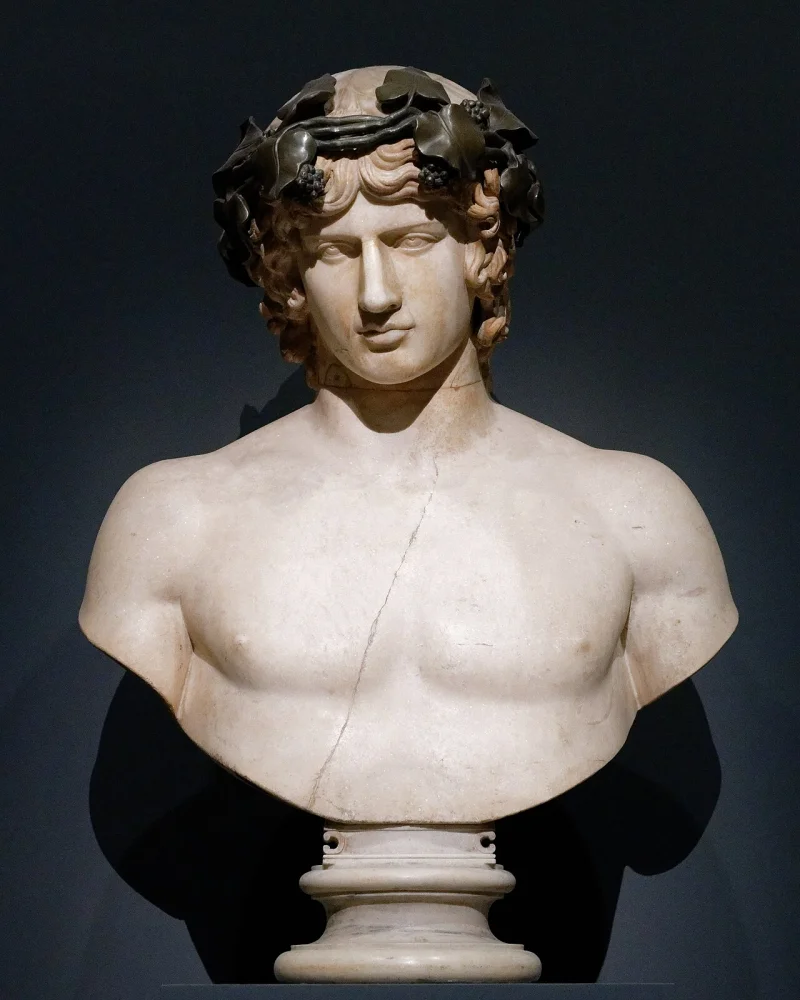
Antinous
Antinous was a young Greek from Bithynia whose life became entwined with that of the Roman emperor Hadrian. A companion on the emperor’s travels and widely understood in antiquity as his beloved, he became one of the most famous figures of the Roman world after drowning in the Nile in 130 CE. Hadrian’s grief transformed him into a figure of worship, and portraits of his calm, idealized face spread across the empire.
From Bithynia to the imperial circle
Antinous was born in Bithynia, in northwestern Asia Minor, probably around 110 CE. The ancient sources say little about his family or early life. He entered Hadrian’s circle while still young and accompanied the emperor on his long provincial journeys. Their relationship has been understood as romantic and sexual by many ancient and modern observers, although the surviving accounts offer little intimate detail.
Hadrian was known for his interest in Greek culture, and Antinous became a prominent presence within the emperor’s traveling court. Inscriptions, coins, and sculptures would later preserve his image far more vividly than the written record preserves his personality.
Death on the Nile
In October 130, during Hadrian’s visit to Egypt, Antinous drowned in the Nile. The circumstances remain uncertain. The emperor’s own account reportedly described an accidental drowning, while later writers repeated rumors that Antinous had deliberately sacrificed himself for Hadrian or died in a ritual act. No surviving evidence settles those stories, and they reveal as much about the shock of his death and the legend that grew around it as they do about the event itself.
Hadrian mourned him publicly and established a new city, Antinoöpolis, near the place where he died. He promoted Antinous as a divine or heroic figure, and a cult formed that was especially influential in the Greek-speaking eastern provinces and Egypt. There, he could be associated with established religious traditions, including Osiris. Shrines, festivals, and games honored him, while statues presented him in the guise of gods such as Dionysus.
An image across an empire
Hundreds of portraits of Antinous survive or are known from antiquity, making his image unusually recognizable for a non-imperial figure. Sculptors gave him youthful features, softly curling hair, and a contemplative expression. These works were not merely private memorials: they helped establish a new cult and carried the emperor’s grief into public space.
The portraits also complicate any attempt to recover the historical person. Their carefully repeated idealized style tells us how Antinous was meant to be seen—as beautiful, youthful, and close to the divine—but offers little insight into his own thoughts or ambitions. The extraordinary scale of the commemoration reflected Hadrian’s power as well as personal loss.
Antinous remains a striking presence in the history of ancient same-sex relationships and Roman religion. His brief life is only faintly documented, yet his posthumous fame endured through temples, coins, and sculpture across the empire. The mystery of his death persists, but the cult Hadrian created ensured that Antinous would be remembered not simply as an emperor’s companion, but as a god with a lasting place in the ancient world.