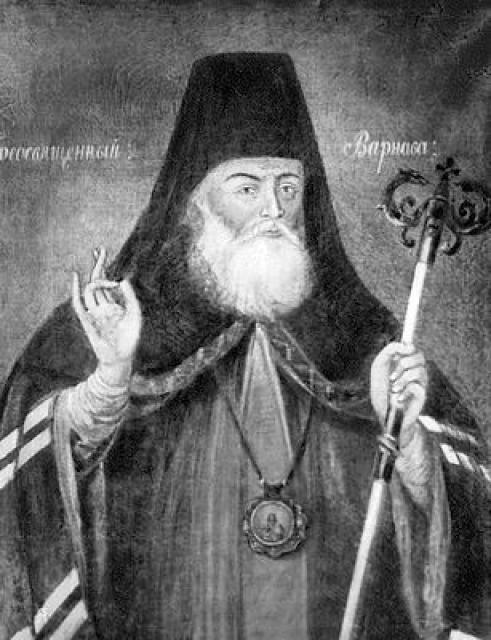
Archbishop Varnava
 Poland
- Early Life and Education
- Service in Moscow
- Elevation to Bishop of Kholmogory and Vaga
- Episcopal Ministry
- Emphasis on Repentance
- Final Years and Legacy
Early Life and Education
Born in 1672 (or 1660) into a Polish royal cavalry family, Varnava received his education at the Kyiv-Mohyla College. Upon graduation, he adopted monasticism and became a teacher at the college.
Service in Moscow
In 1705, Varnava relocated to Moscow. As a hieromonk, he served as a preacher at the Zaikonospassky Monastery and a teacher and preacher at the Moscow Slavic-Greek-Latin Academy.
Elevation to Bishop of Kholmogory and Vaga
On August 24, 1712, Varnava was consecrated as Bishop of Kholmogory and Vaga and elevated to Archbishop. En route to his diocese, he was delayed on the frozen Sukhona River. During his three-week stay at the Agapitov Markushevo Nikolsky Monastery, he composed a "Brief History" of the monastery. He arrived in Kholmogory no earlier than November 21, 1712.
Episcopal Ministry
On December 6, 1712, Varnava authorized the construction of the main altar dedicated to the Protection of the Most Holy Theotokos in the lower church of the Mikhail-Arkhangelsky Monastery. In 1714, he established a school at the Korelsky Nikolsky Monastery.
Varnava's numerous missives to his flock exemplified his combination of strictness and tolerance. He emphasized the importance of adhering to church rituals but cautioned against demanding excessive spiritual feats from ordinary parishioners.
Emphasis on Repentance
Varnava placed great significance on repentance. He declared, "The time for repentance is always at hand, morning and evening, day and night, and when necessary, even after eating and drinking."
Final Years and Legacy
In his final two years, Varnava suffered severe arthritis. He passed away on October 8, 1730, and was buried in the Kholmogory Transfiguration Cathedral.


