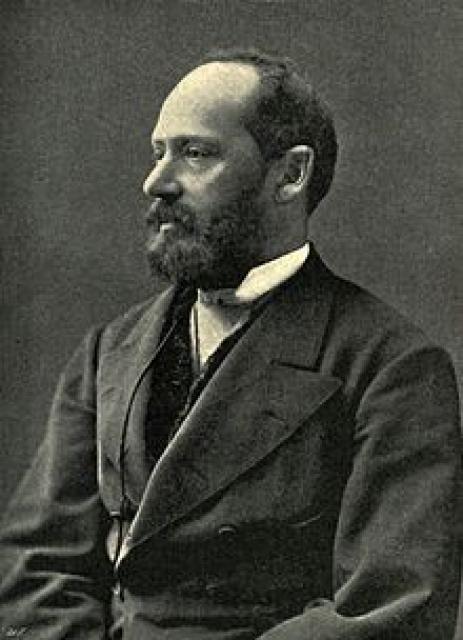
Armin Vambery
 Hungary
- Early Life and Education
- Journey to the Ottoman Empire
- Scholarly Achievements
- Expedition to Central Asia
- Return to Europe
- Academic Career and Legacy
- Political Connections
- Literary Impact
- Family and Legacy
Early Life and Education
Armenius Vambery was born into a poor Jewish family in Hungary. He pursued his education in Bratislava, Vienna, Kecskemét, and Budapest.
Journey to the Ottoman Empire
Passionate about Ottoman culture, Vambery embarked on a journey to Istanbul with József von Eötvös at the age of 20. He earned a living by teaching European languages and later became a secretary to Mehmed Fuad Pasha.
Scholarly Achievements
Around this time, Vambery published his "Turko-German Dictionary" (1858) and several linguistic works. He became a corresponding member of the Hungarian Academy of Sciences.
Expedition to Central Asia
In 1861, Vambery returned to Budapest and secured funding from the academy. Disguised as a dervish named Reshid Effendi, he traversed the Middle East, visiting Iran, Bukhara, and Khiva. His journey aroused suspicion, but his eloquence secured him safe passage.
Return to Europe
Vambery returned to Europe via Herat and Tehran, reaching Istanbul in 1864. His expedition was likely the first of its kind for a European explorer.
Academic Career and Legacy
From 1865 to 1905, Vambery taught Eastern languages at the University of Budapest. He authored numerous works in German, Hungarian, and English, including his autobiography. His theories on the Turkic origins of Hungarian language were contested.
Political Connections
Through his connections in the Ottoman Empire, Vambery sought to advance his interests. He converted to Islam multiple times and attempted to facilitate a meeting between Theodore Herzl and Sultan Abdul Hamid II.
Literary Impact
Vambery was acquainted with Bram Stoker, providing historical and ethnographic insights for his novel "Dracula" (1897).
Family and Legacy
Vambery's son, Rustem Vambery, became a prominent Hungarian jurist and diplomat. Armenius Vambery's works continue to be translated and studied today, leaving a lasting impact on Oriental studies and beyond.


