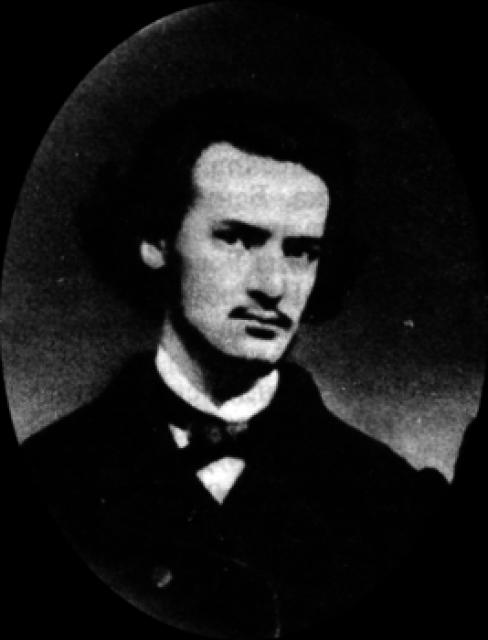
Artur Benni
 Russia
- Early Life and Education
- Embracing Russian Socialism
- Exile and Rehabilitation
- Journalism and Death
- Literary Contributions and Legacy
- Sources and Bibliography
Early Life and Education
Arthur Ivanovich Benny was born in 1840 in Tomaszów Rawski, Poland. His father, Johann Benny, was an evangelical pastor and Hebrew scholar, while his mother was English. Benny's upbringing in a cosmopolitan family instilled in him proficiency in Polish, English, and Russian.
Growing up, Benny displayed an idealistic nature and an affinity for socialist ideas. Despite the anti-Russian sentiments that permeated his surroundings, he developed a fascination with Russian communal institutions and the potential he saw in the Russian people for realizing socialist ideals.
Embracing Russian Socialism
In 1861, Benny emigrated to Russia with the intention of contributing to its liberation. He gathered signatures for a petition to the tsar demanding a constitution and became acquainted with prominent radicals such as Alexander Herzen, Mikhail Bakunin, and Nikolai Ogarev.
Benny's initial zeal waned as he realized the futility of his agitation and the challenges of spreading socialism in Russia. He was implicated in the "Trial of the Thirty-Two" for alleged secret communications with London and was sentenced to imprisonment and exile as a foreign national.
Exile and Rehabilitation
Undeterred by his expulsion from Russia, Benny sought to rehabilitate his reputation as a spy. He wrote a petition to be accepted into Russian citizenship, but it was met with rejection. Despite the efforts of Nikolai Leskov and Ivan Turgenev to clear his name, the stigma remained.
Journalism and Death
Forced to leave Russia, Benny settled in Switzerland and pursued journalism. He reported for English newspapers, covering Garibaldi's military campaigns. Tragically, he was wounded in the Battle of Mentana and passed away in 1867.
Literary Contributions and Legacy
Benny contributed to various Russian periodicals, including "Russkaya Rech," "Epokha," and "Biblioteka dlya Chteniya." He also translated Bulwer-Lytton's novel "The Last Days of Pompeii" into Russian. Nikolai Leskov immortalized him as the character Rainer in his novel "Ne Kuda."
Sources and Bibliography
Vengerov, S. A. "Kritiko-biografichesky slovar russkikh pisateley i uchenykh." Vol. III, pp. 1-5.
Lemke, M. "Protsess 32-kh." In "Ocherki osvoboditelnogo dvizheniya 60-kh godov." St. Petersburg, 1908.


