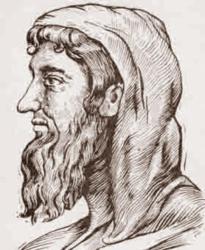
August Mobius
 Germany
Biography of August Möbius
August Möbius was a German mathematician and theoretical astronomer. He was born in the territory of the princely school of Schulpforta, near Naumburg, Saxony-Anhalt. His father held the position of dance teacher at this school, and his mother was a descendant of Martin Luther. Tragically, his father passed away when Möbius was only three years old.
Möbius received his early education at home and showed an immediate interest in mathematics. From 1803 to 1809, he studied at the Schulpforta College and then enrolled at Leipzig University. Initially, Möbius studied law for the first six months, as recommended by his family, but he eventually made the definitive decision to dedicate his life to mathematics and astronomy. It is believed that the influence of the renowned astronomer and mathematician Möllweide, who taught at Leipzig University, played a role in his choice.
In 1813-1814, Möbius lived in Göttingen, where he attended Carl Friedrich Gauss's lectures on astronomy. He then moved to Halle to attend Johann Pfaff's mathematics lectures, who was Gauss's teacher. As a result, Möbius gained profound knowledge in both disciplines.
During his doctoral studies in 1815, there was an attempt to draft Möbius into the Prussian army. Despite this threat, he successfully obtained his doctorate degree. Around this time, Möbius's mentor Möllweide moved to the mathematics department and recommended Möbius for the vacant chair of astronomy at Leipzig, as an extraordinary professor. From 1816, he worked as an astronomer-observer and later as the director of the Pleißenburg Observatory near Leipzig. He actively participated in the reconstruction and equipping of the observatory.
In 1820, Möbius got married, and he had two sons and a daughter. In 1825, Möllweide passed away, and Möbius attempted to replace him, but his reputation as a teacher was not significant enough, and the university selected another candidate. However, upon learning that Möbius received invitations from other universities, the university administration promoted him to the position of an ordinary professor of astronomy. By this time, Möbius's mathematical research had brought him recognition in the scientific world.
In 1848, Möbius became the director of the observatory. His article on the famous Möbius strip was published posthumously.
In honor of the scientist, an asteroid 28516 (Möbius) was named after him. In 1858, he established the existence of one-sided surfaces and became famous as the inventor of the Möbius strip, the simplest non-orientable two-dimensional surface with a boundary that can be embedded into three-dimensional Euclidean space. In the professional community, Möbius is known as the author of numerous outstanding works in geometry, particularly projective geometry, analysis, and number theory.
Möbius introduced homogeneous coordinates and analytical methods of investigation in projective geometry. He provided a new classification of curves and surfaces, established the general concept of projective transformation, later named after him, and explored correlation transformations.
Möbius also published the two-volume "Guide to Statics" (1837) and the highly original and rich in mathematical ideas book "Barycentric Calculus" (1827), which introduced barycentric coordinates of points in the plane. Both of these books also belong to projective geometry and its applications.
He was the first to consider spatial algebraic curves of the third order and studied their properties.
In the field of number theory, Möbius's name is associated with the Möbius function μ(n) and the Möbius inversion formula.
In 1840, long before the famous four-color theorem, Möbius formulated a similar problem: is it possible to divide a country into five parts, with each part having a non-zero boundary with all the others? It can be easily shown that this is impossible. Among his other topological achievements, he introduced the concept of a unicursal curve, a graph that can be drawn without lifting the pen from the paper.
In the field of astronomy, Möbius published several significant works on celestial mechanics, the principles of astronomy, and planetary eclipses.