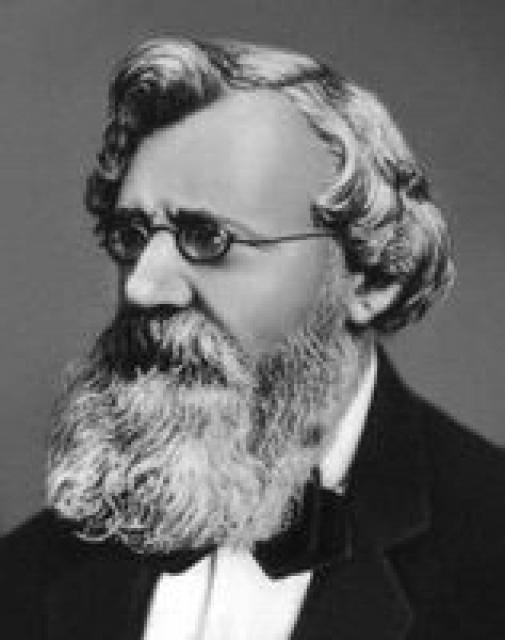
August-Vilhelm Hofmann
 Germany
Biography of August Wilhelm Hofmann
August Wilhelm Hofmann was a German organic chemist who developed the scientific foundations of dye chemistry. He was born on April 8, 1818, in Giessen, Germany. Hofmann completed his education at the University of Giessen, where he was taught by J. Liebig. After obtaining his doctorate in chemistry, he became Liebig's assistant in 1843 and later a privat-docent at the University of Bonn in 1845.
Career and Contributions
In 1845, Hofmann became the first director of the newly established Royal College of Chemistry in London, where he worked for 20 years. In 1865, he became the head of the chemistry department at the University of Berlin, a position he held until his death. In 1868, Hofmann founded the German Chemical Society.
Hofmann's main area of research was the synthesis and study of amines. In 1843, he demonstrated that products obtained at different times by Unferdorben, Runge, Fritzsche, and Zinin, which were considered different substances, were actually the same compound. He named this compound aniline, following Fritzsche's suggestion. In 1845, Hofmann isolated benzene from coal tar. In 1850, he showed that heating ethyl iodide with ammonia produces amines. In 1881, he proposed a method for obtaining primary amines from carboxylic acid amides, known as the Hofmann reaction.
Hofmann was also involved in the synthesis of various compounds, including the first aniline dye, mauveine, by his student William Perkin in 1856. He himself synthesized aniline red (fuchsine), formaldehyde, hydrazobenzene, and isonitriles. Hofmann was one of the first to recognize and introduce into teaching practice the new system of atomic weights proposed by S. Cannizzaro, based on A. Avogadro's hypothesis. He developed numerous chemical demonstrations that are still used today. His book "Einleitung in die moderne Chemie" (Introduction to Modern Chemistry, 1865) was one of the most popular scientific textbooks of the time.
Legacy and Honors
In 1888, Hofmann was granted the title of nobility. He passed away on May 5, 1892, in Berlin. August Wilhelm Hofmann's contributions to organic chemistry and dye chemistry laid the foundation for future developments in the field. His research, teachings, and experiments continue to inspire and educate scientists to this day.


