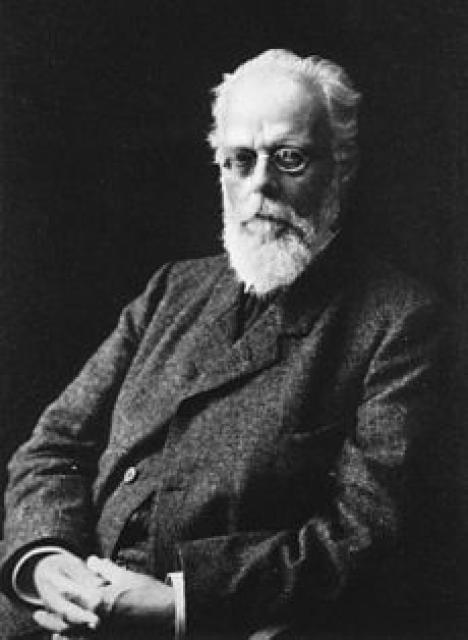
August Weismann
 Germany
- August Weismann: German Zoologist and Evolutionary Theorist
- Academic Career
- Early Research
- Theoretical Investigations
- Materialism and Anti-Vitalism
- Inheritance of Acquired Traits
- Germ Plasm Theory
- Legacy
- Misrepresentation and Rehabilitation
August Weismann: German Zoologist and Evolutionary Theorist
Early Life and EducationAugust Weismann was born in Frankfurt am Main, Germany, in 1834. He studied medicine and natural sciences at the University of Göttingen from 1852 to 1856.
Academic Career
After graduating, Weismann became a private lecturer in Würzburg in 1863. In 1873, he was appointed professor of zoology at the University of Freiburg, where he taught until 1912.
Early Research
Weismann's early research focused on histology, insect development, and the biology of freshwater organisms. His work on the cellular structure of muscle tissue was particularly notable.
Theoretical Investigations
From the late 1860s, Weismann transitioned to theoretical investigations in evolutionary biology. He became a staunch defender and proponent of Charles Darwin's theory of evolution.
Materialism and Anti-Vitalism
Weismann espoused a materialist understanding of biological phenomena. He rejected vitalism, the belief that life is governed by non-physical forces. He also criticized Lamarckism, which posited that acquired characteristics could be inherited.
Inheritance of Acquired Traits
Weismann argued that the question of the inheritance of acquired traits could only be answered empirically. He conducted experiments showing that mechanically induced injuries were not inherited.
Germ Plasm Theory
Weismann proposed the concept of germ plasm, which he believed was the hereditary material responsible for development and inheritance. Although imperfect in its details, this theory foreshadowed modern understandings of genetics and the role of chromosomes.
Legacy
Weismann's ideas were initially met with resistance from some quarters, but they eventually found wide acceptance in the field of evolutionary biology. His theories on inheritance paved the way for modern understandings of genetics and DNA.
Misrepresentation and Rehabilitation
In the late 1940s, Weismann's theory, which he called Neo-Darwinism, was unfairly maligned as anti-scientific and reactionary by the followers of Lysenkoism. However, Weismann's work was a legitimate and significant contribution to the development of evolutionary thought.