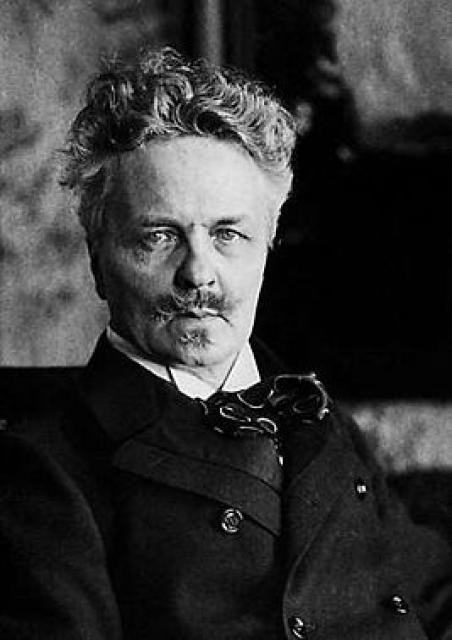
Avgust Strindberg
 Sweden
- August Strindberg: A Literary Giant of Sweden
- The Emergence of a Naturalist Writer
- The Radical Democrat
- A Shift in Perspective
- The Nietzschean Phase
- The Mystical and the Occult
- Strindberg's Legacy
August Strindberg: A Literary Giant of Sweden
Early Life and InfluencesBorn in 1849 to a businessman father and a maid, August Strindberg's early years were marked by poverty and instability. He pursued various occupations, including teacher, librarian, and actor, before embarking on his literary career.
The Emergence of a Naturalist Writer
In the 1870s, Strindberg emerged as a prominent writer, debuting with his dramas "Rome" and "Master Olof." His breakthrough came in 1879 with the novel "The Red Room," which sparked a fierce debate about contemporary Swedish society. Drawing upon naturalism and positivism, Strindberg criticized societal hypocrisy, bureaucratic corruption, and the power of capital.
The Radical Democrat
Strindberg became a literary leader of Sweden's radical-democratic intelligentsia, advocating for social equality, women's liberation, and pacifism. He was influenced by utopians like Fourier and Saint-Simon, and briefly considered himself an "agrarian socialist." His novel "Hemsöborna" (The Islanders) portrayed the simplicity of rural life.
A Shift in Perspective
In the late 1880s, the rise of industrial capitalism led Strindberg to question his earlier beliefs. He began to doubt socialism's transformative potential and instead celebrated the power of the individual and the inevitability of social hierarchies. This shift was reflected in his plays, such as "The Father," "Comrades," and "Miss Julie," which explored the power dynamics between men and women.
The Nietzschean Phase
Strindberg became increasingly influenced by Nietzsche's philosophy and rejected his earlier faith in science. In his historical dramas, he depicted heroic individuals like Gustav Vasa and Martin Luther who defied society's norms. His novels, such as "Havsbandet" (By the Open Sea), portrayed the ruthless struggle for power within the capitalist elite.
The Mystical and the Occult
In the 1890s, Strindberg abandoned positivism and embraced the occult. He became a proponent of Catholicism and incorporated spiritual themes into his works, such as "Inferno" and "Legends." Elements of depression and decadence crept into his writing during this period.
Strindberg's Legacy
Strindberg's literary journey reflected the profound societal transformations of his time. His early works reflected the resistance of the Swedish peasantry to industrialization, while his later works embraced the rise of capitalism and the ensuing social conflicts. His naturalism evolved into an early form of expressionism, characterized by a fragmented and subjective perception of reality.
Strindberg's influence extended beyond Sweden, inspiring figures like Maxim Gorky and the Symbolist movement. His works remain a testament to the human condition, exploring the complexities of power, gender, and the struggle between individual and society.



