Bede
- A life in the monastery
- A historian of the English people
- Scripture, science and the calendar
- Final days and legacy
Bede, later known as the Venerable Bede, was a Northumbrian monk whose scholarship shaped how medieval Europe understood history, scripture and time. A gifted teacher and prolific author, he spent nearly his entire life in the monasteries of Wearmouth and Jarrow in what is now northeast England. His “Ecclesiastical History of the English People” remains a foundational source for the early history of England.
A life in the monastery
Bede was born around 672 or 673 in Northumbria, probably on land near the twin monasteries of Wearmouth and Jarrow. At about seven, he was placed in the care of the abbot Benedict Biscop and later studied under Ceolfrith. The monastery’s library, enriched by books brought from across Europe, gave the young monk access to a remarkable range of classical and Christian learning.
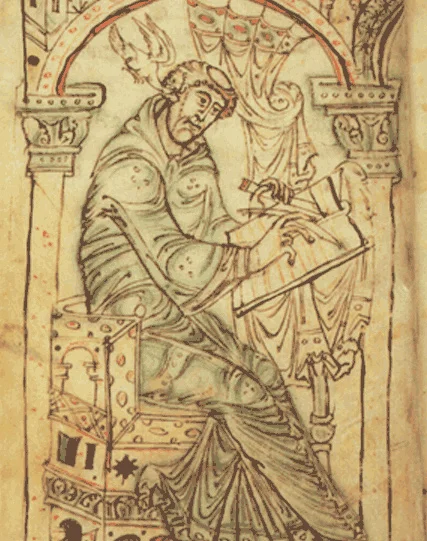
Bede became a deacon at nineteen and a priest at thirty. He taught and wrote within the monastery, following its daily cycle of prayer and study. In the autobiographical note he added to his history, he described his life as devoted to learning, teaching and writing. He rarely traveled, but his works circulated widely among scholars and church leaders.
A historian of the English people
Completed around 731, the “Ecclesiastical History of the English People” traces the spread of Christianity in Britain and the development of the Anglo-Saxon kingdoms. Bede drew on written records, oral accounts and his own inquiries. His method of naming sources and comparing testimony helped make the book unusually valuable to later historians.
The history is also a work of religious interpretation. Bede presented the conversion of the English peoples as part of a larger Christian story, and his perspective reflected the church politics of his time. Even so, without his careful account, much of what is known about early medieval England would be far harder to reconstruct. For this reason he is often called the “father of English history.”
Scripture, science and the calendar
Bede wrote more than a history. He produced biblical commentaries, lives of saints, works on grammar and nature, and treatises on chronology. His “The Reckoning of Time” explained how to calculate the date of Easter and described cycles of the sun and moon. In this work and in his historical writing, he used the “Anno Domini” system developed earlier by Dionysius Exiguus, helping spread the practice of dating events from the traditionally calculated year of Christ’s birth.
His scholarship connected the Northumbrian monastery to wider intellectual networks. Bede’s books were copied and read across Europe, and later writers treated him as a major authority on both religious and historical subjects.
Final days and legacy
Bede died at Jarrow on May 26, 735. A letter by his student Cuthbert recounts that he continued working and praying during his final illness. His reputation as “the Venerable” grew soon after his death, and the Catholic Church later recognized him as a Doctor of the Church.
Bede’s enduring achievement is the breadth of his curiosity joined to disciplined scholarship. His history gave later generations a window onto early England, while his work on time, scripture and learning helped shape the intellectual life of medieval Europe.