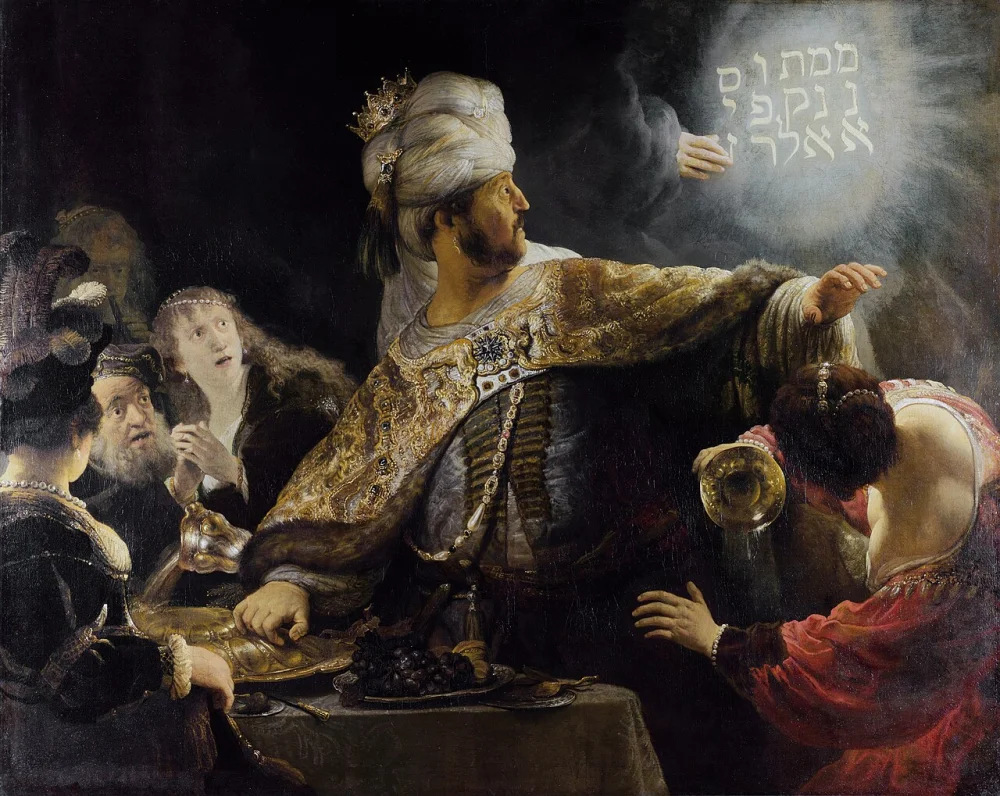
Belshazzar
Belshazzar was the crown prince who governed Babylon while his father, King Nabonidus, spent years away from the capital. He is best known today from the biblical Book of Daniel, where he appears as the last king of Babylon at a dramatic royal feast. Babylonian inscriptions confirm that Belshazzar was a real historical figure with substantial authority, while leaving the celebrated feast and the details of his final hours uncertain.
The crown prince of Babylon
Belshazzar was the son of Nabonidus, who became king of the Neo-Babylonian Empire in 556 BCE. Around the middle of his reign, Nabonidus left Babylon and established himself for an extended period at Tayma, an oasis in Arabia. The reasons for his long absence remain debated, but cuneiform records show that his son was entrusted with important responsibilities in the capital.
Belshazzar’s position was powerful, though he was not formally crowned king in the surviving Babylonian royal inscriptions. He could conduct military and administrative business and act as the king’s representative. This helps explain why later traditions could remember him as a ruler even though his father retained the official kingship. His place in the royal order also echoes a detail in Daniel, where the reward for interpreting a mysterious message is the promise of becoming “third ruler” in the kingdom.
The feast and the fall
In Daniel 5, Belshazzar hosts a lavish feast and orders sacred vessels taken from the Jerusalem temple to be brought in. A mysterious hand writes words on the wall, which the prophet Daniel interprets as a warning that the king’s rule has been weighed and will soon end. The story concludes with Babylon falling to the Medes and Persians and Belshazzar being killed.
The biblical episode became one of the most enduring stories associated with ancient Babylon, inspiring the expression “the writing on the wall” for a clear sign of impending disaster. Contemporary Babylonian records confirm the Persian capture of Babylon in 539 BCE but do not describe the feast or provide a clear account of Belshazzar’s fate. As a result, the central details of Daniel’s story cannot be independently verified from the surviving records.
A historical figure behind a famous story
Belshazzar’s historical importance became clearer when scholars deciphered cuneiform inscriptions that named him as Nabonidus’s son and heir. Before those discoveries, he was known chiefly through biblical and later classical accounts. His career reveals how authority could be shared in practice even when formal kingship remained with an absent ruler.
He remains a figure at the intersection of history and religious memory: a crown prince with real power in the final years of the Babylonian Empire, and the central character in a famous story about pride, judgment, and the sudden collapse of a kingdom.


