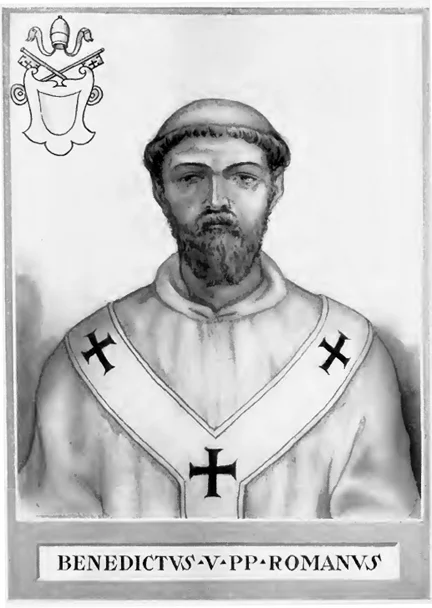
Benedict V
Known as “Grammaticus” for his learning, Benedict V became pope during a fierce contest over who had the right to lead the Church and influence Rome. His pontificate lasted only about a month in 964. Deposed by Emperor Otto I and sent north to Hamburg, he spent the rest of his life far from the city where he had been chosen.
A Scholar in a Divided Rome
Benedict was a Roman deacon and cardinal-deacon before his election. Little is securely recorded about his early life, but contemporary accounts describe him as learned, a reputation reflected in his nickname, “Grammaticus.” His rise came at a moment when the papacy was entangled in the power struggle between Rome’s ruling factions and Otto I, the king of Germany and Italy who would later be crowned emperor.
In 963, Otto had intervened in Rome and backed the installation of Leo VIII while Pope John XII was still alive. John returned to the city and regained control, but died in May 964. With Otto away, the Romans rejected Leo and elected Benedict on May 22. The choice was an assertion of local authority, but it challenged the emperor’s preferred settlement.
A Pontificate of Four Weeks
Otto marched back to Rome to enforce his position. The city endured a siege, and contemporary chroniclers say that famine weakened the resistance. On June 23, 964, Benedict was deposed at a synod held under imperial authority, and Leo VIII was restored. Accounts differ in tone and in the details of the proceedings, but the essential outcome is clear: Benedict’s papacy ended under pressure from Otto’s military and political power.
Benedict was stripped of the symbols of office and reduced to the rank of deacon. He was then sent to Hamburg, where he was placed in the care of Archbishop Adaldag. The exile kept him away from Rome and from the factional conflict that had shaped his brief time as pope. Some German clergy continued to regard him as the legitimate pontiff, underscoring that the dispute over his status did not vanish with his removal.
Exile and Reputation
Despite his deposition, Benedict appears to have been treated with respect in Hamburg. He died there, probably in 965 or 966; sources do not agree on the precise year. His memory became associated both with his reputation for scholarship and with the turbulent political conditions of tenth-century Rome.
Benedict V’s short tenure illustrates how the papacy could be caught between Roman political factions and the ambitions of powerful rulers beyond the city. He had almost no time to shape Church policy, yet his election and removal became part of a larger debate about imperial influence and the independence of Rome’s religious leadership. Later generations remembered him as a learned man whose papacy was brief, contested, and ended in exile.