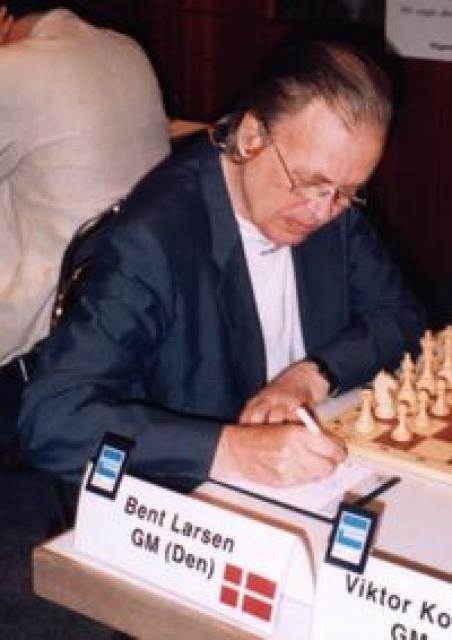
Bent Larsen
 Denmark
- Biography of Bent Larsen
- Early Life and Chess Education
- Early Career
- Contender for World Championship
- Playing Style and Personality
- Successes and Setbacks
- Legacy
Biography of Bent Larsen
IntroductionBent Larsen, born Jørgen Bent Larsen on March 4, 1935, was a Danish grandmaster and a contender for the World Chess Championship in the 1960s and 1970s. He was known for his sharp combinational style of play and his expertise in the Royal Gambit opening.
Early Life and Chess Education
Larsen learned to play chess at the age of 7, with his first teacher and partner being a schoolmate. At the age of 12, Larsen began studying chess literature independently, with a particular influence from a book on the Royal Gambit, which he described as a powerful opening that no one could resist. Larsen excelled academically in school and quickly grasped the intricacies of chess, consistently becoming the top player in his club, city, province, and eventually, the country by the age of 19.
Early Career
In 1956, Larsen represented Denmark as the top board player in the World Chess Olympiad in Moscow, where he achieved the best result. It was during this time that he was awarded the title of grandmaster. Despite a setback in the 1958 Interzonal Tournament, Larsen still participated in the Candidates Tournament in Yugoslavia as a second to Robert Fischer. Interestingly, Larsen never had a coach himself, preferring to train independently and considering his wife, Lizzie, as his best assistant. She helped him prepare for games and believe in his abilities.
Contender for World Championship
In 1964, Larsen became a contender for the World Chess Championship, sharing 1st to 4th place in the Interzonal Tournament in Amsterdam. In that cycle, he reached the semifinals but narrowly lost to Mikhail Tal with a score of 4.5:5.5. In 1966, Larsen won the international tournament in Gothenburg, outperforming Soviet grandmasters Lev Polugaevsky and Nikolay Krogius by two points. Polugaevsky was particularly impressed by Larsen's play and published an article praising his strategic abilities.
Playing Style and Personality
Polugaevsky noted Larsen's versatility as a chess player and compared him to Aron Nimzowitsch for his dynamic and strategically focused play. Larsen had a deep understanding of chess theory and closely followed the literature. Despite his love for solitude, Larsen was sociable and friendly, with a calm demeanor both at the chessboard and in everyday life. He was well-educated and had knowledge of several European languages, including Russian. Larsen's wife was intelligent and charming, and their harmonious family life brought him confidence.
Successes and Setbacks
In 1967, Larsen had a remarkable year, winning three consecutive major tournaments in Havana, Winnipeg, and Palma de Mallorca. His success in the Interzonal Tournament in Sousse solidified his position as one of the top contenders for the World Chess Championship. He was also the recipient of the first Chess Oscar in 1967. However, in 1971, Larsen faced a crushing defeat in the Candidates Match against Fischer, losing with a score of 0:6.
Legacy
Larsen's career included over 40 international tournament victories, including prestigious events. He led the World team in the "Match of the Century" against the Soviet Union in 1970. Larsen wrote a book called "50 Selected Games" and developed the Larsen Opening (1.b2-b3), which brought him many successes against the world's strongest players. Despite his numerous achievements, Larsen acknowledged the presence of a few players who consistently outperformed him, which prevented him from becoming the World Chess Champion.


