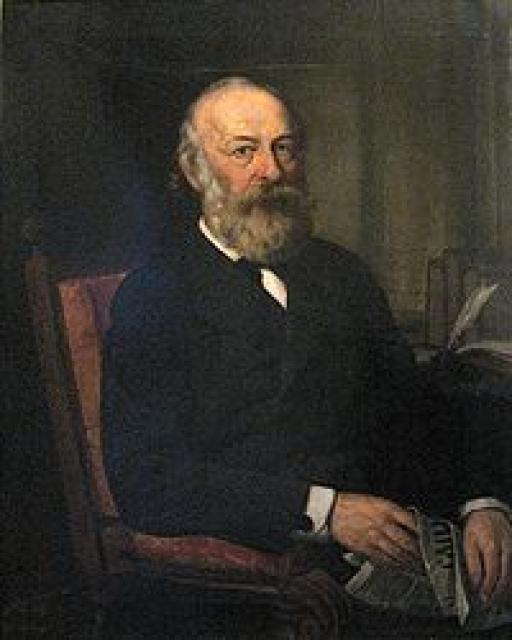
Bogdan Gegitskiy
 Ukraine
- Biography of Bohdan Dedițky
- Education and Early Works
- Literary Career
- Language and Cultural Unity
- Journalism and Later Years
- Bohdan Dedițky was laid to rest at the Lviv Lychakiv Cemetery.
Biography of Bohdan Dedițky
Bohdan Dedițky was the first professional Galician-Russian journalist, writer, and poet. He was born in the village of Uhniv in the Rava-Ruska district, into the family of a rural Uniate priest. At birth, he was named Feodosiy (Theodosiy), and his twin brother was named Ludvik.
Education and Early Works
Dedițky studied at gymnasiums in Lviv and Przemyśl, and later at the University of Vienna, where he studied Slavic philology under the guidance of the Slavist F. Miklošič. In 1848, he attempted to translate "The Tale of Igor's Campaign" into verse. During the Hungarian campaign of the Russian troops in 1849, Dedițky met a Russian regimental priest. Influenced by this event, Dedițky became a supporter of the idea of unity among the Russian people and wrote a brochure titled "Learn to Speak Little Russian in One Hour in Great Russian" (Lviv, 1866).
Literary Career
In 1853, Dedițky published his novella "The Groom" under the influence of the poetry of Pushkin, Lermontov, and Shevchenko, as well as the collection "Songs of the Russian Kobzar," in which he presented himself as a folk singer. His fame came with the three-song poem "Buĭ-tur Vsevolod, Knyaz Kursky" (1860). Despite its popularity, Dedițky's romantic poem was far from historical reality and showed clear traces of imitation of Pushkin and Byron.
Language and Cultural Unity
After reading "Eneida" by I. P. Kotlyarevsky and stories by H. P. Kvitka-Osnovianenko, Dedițky became determined to create Ukrainian national democratic literature. However, as he became familiar with the works of Pushkin, Lermontov, and especially Gogol, whom he considered a "genius Khokhloma" who enriched the Russian literary language, Dedițky came to the conviction of the necessity of linguistic and cultural rapprochement with Russia. He believed in creating a literary language that would be understandable to both Austro-Hungarian Rusyns and Russians, becoming their common heritage.
Journalism and Later Years
With the support of patron Mikhail Kachkovsky, Dedițky began publishing the newspaper "Slovo" in 1861. In the same year, he published the almanac "Halychska Zoria - Album," which featured Galician-Russian writers of the time. Shortly before his death, he published his personal notes and memoirs under the title "Vivid Life Notes" (1908), in which he wrote that he aspired to imitate folk poetry (Russian bylinas, Cossack dumas, Galician kolomyikas) and learned from writers and poets such as Derzhavin, Pushkin, Lermontov, Gogol, Krylov, Shevchenko, Kotlyarevsky, Khomyakov, and Kvitka-Osnovianenko.