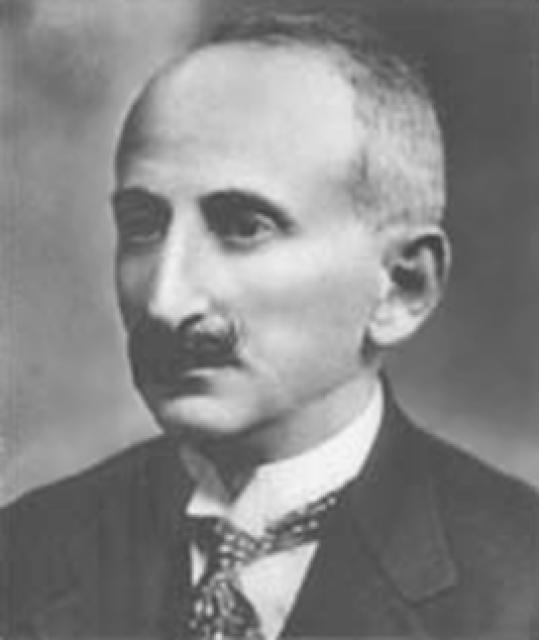
Boleslaw Lesmian
 Poland
- Bolesław Leśmian: Polish Poet and Literary Innovator
- Debut and Literary Recognition
- Literary Exploration and Travail
- Return to Poland and Creative Breakthrough
- War, Separation, and Literary Leadership
- Notarial Appointment and Financial Misfortune
- Heart Attack and Literary Recognition
- Literary Heritage
- Symbolist-Impressionist (1895-1901)
- Family Legacy
Bolesław Leśmian: Polish Poet and Literary Innovator
Early Life and InfluencesBolesław Leśmian (1877-1937) was a Polish poet of Jewish descent who wrote in both Polish and Russian. Born into a literary family, he was the grandson of publisher Bernard Leśman and great-grandson of writer Antoni Eisenbaum. From 1881, Leśmian resided in Kyiv.
Debut and Literary Recognition
In 1895, under the mentorship of his cousin Antoni Lange, Leśmian debuted with the poem "Sextins" in the magazine "Wędrowiec." His early works were rejected by respected publications due to their unconventional style. After graduating from high school in 1896, Leśmian enrolled in the law faculty at Kyiv University. In 1897, he adopted the pseudonym "Leśmian" and published his first notable work. A prestigious Krakow journal recognized his sonnets in a competition.
Literary Exploration and Travail
Leśmian attended literary salons, traveled through Ukraine, and participated in secret patriotic circles. His recitation of patriotic poems led to a brief imprisonment. After graduating from university in 1901, he moved to Warsaw and worked as a legal assistant. Through Lange's patronage, he entered literary circles in the capital.
In 1903, Leśmian traveled to Paris, where he faced financial hardship. He translated works by Verlaine, Verhaeren, and Poe for income. In 1904, he married artist Zofia Chylińska, and they welcomed a daughter in 1905. Leśmian established connections with Russian Symbolist poets such as Balmont, Merezhkovsky, and Bely.
Return to Poland and Creative Breakthrough
Towards the end of 1906, Leśmian returned to Poland. His Russian poems appeared in prestigious Polish literary magazines. In 1908, another daughter was born into his family. From 1909-1913, he published literary and theater reviews in "Nowa Gazeta." He spent the years from 1911 to 1914 in Italy and France.
War, Separation, and Literary Leadership
Upon returning to Poland during World War I, Leśmian entrusted his daughters to family and friends. In 1916, he became literary director of the Polish Theater in Łódź. He returned to Warsaw in 1917.
Notarial Appointment and Financial Misfortune
In 1918, Leśmian was appointed notary in Hrubieszów. In 1922, he was promoted to senior district notary in Zamość. However, in 1929, an audit revealed an embezzlement of 30,000 złoty under his supervision. Facing imprisonment, Leśmian sold his wife's jewelry and land, indebting himself heavily.
Heart Attack and Literary Recognition
In 1932, Leśmian suffered a severe heart attack. Through government connections, a poet friend helped him clear most of the incriminated embezzlement. In 1934, Leśmian was elected to the Polish Academy of Literature, securing him a lifelong stipend. He retired from the notary position in 1935 and returned to Warsaw with his family.
Literary Heritage
Leśmian was a highly original and unconventional author. Literary critic Piotr Łopuszański divided his career into four periods:
Symbolist-Impressionist (1895-1901)
Parnassian (1901-1910)Discovery and Crystallization of Own Poetics (1910-1928)
Existentialism (1929-1937)
In his works, inanimate objects and abstract concepts gained a life of their own, blending reality with myth. Leśmian drew inspiration from Slavic mythology, creating his unique and fantastical poetic landscape. His works have been translated into Polish by Jerzy Ficowski.
Family Legacy
Leśmian's cousin was renowned writer Jan Brzechwa. His uncle was Antoni Lange, who influenced his literary development.


