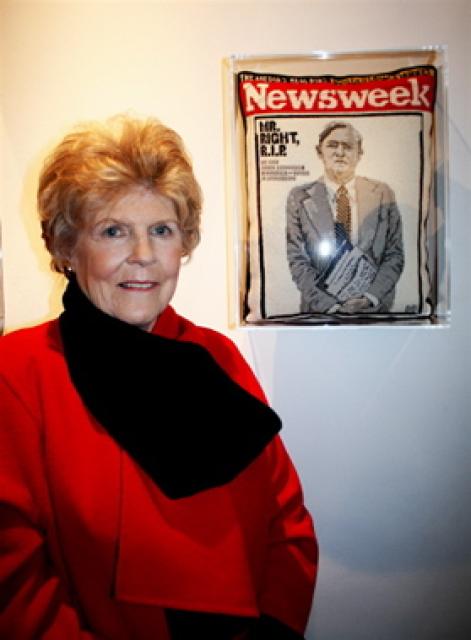
Brigid Berlin
 USA
- A Debutante Who Would Not Behave
- The Factory and Warhol
- An Archive of the Scene
- Later Years and Recognition
Brigid Berlin moved from Fifth Avenue high society into Andy Warhol’s downtown world and made a life out of refusing to fit the part assigned to her. Known as a Warhol “superstar,” she appeared in his films, ran his studio, and became one of his closest friends. She also made her own work: thousands of Polaroids, hours of tape recordings, performances, needlepoint, and deliberately provocative body prints that turned the scrutiny she had endured into material of her own choosing.
A Debutante Who Would Not Behave
Brigid Emmett Berlin was born in Manhattan on September 6, 1939. Her father, Richard E. Berlin, headed the Hearst media company, and her mother, Muriel “Honey” Johnson Berlin, was a prominent New York socialite. The family’s Fifth Avenue apartment looked out over Central Park, and its guests included politicians and Hollywood stars. Yet Berlin later described an uneasy childhood in which her mother fixated on her weight. As a child, she was given appetite-suppressing drugs and sent away to boarding school with orders that she lose weight. Her time at a Swiss school ended after she was expelled for drinking and misbehavior; she finished her education at the Convent of the Sacred Heart in Pennsylvania.
In 1960, at 21, she married window dresser John Parker. The brief marriage soon collapsed. Berlin left the polished social world she had been raised for and found her way into New York’s underground art scene. Her rebellion was loud, theatrical, funny, and often pointed directly at the conventions that had tried to govern her body and behavior.
The Factory and Warhol
Berlin met Warhol at his studio, the Factory, in 1964. She started out as a receptionist but quickly became part of the inner circle, a friend and collaborator rather than simply a visitor passing through. Warhol’s nickname for her was “The Duchess,” a joke about her blue-blooded origins. Berlin’s own nickname, “Brigid Polk,” referred to the amphetamine injections she used and sometimes administered to friends. The drug use, which had roots in the appetite-control culture of her childhood, became part of her notoriety. She later went through rehabilitation and was free of drugs by the early 1990s.
Her scene-stealing appearance in Warhol and Paul Morrissey’s 1966 film Chelsea Girls made her a cult figure. She played a version of herself: commanding, talkative, and impossible to ignore. In the film, her on-screen drug use blurred the boundary between performance and real life in a way that became characteristic of the Factory’s experimental films. She went on to appear in several other Warhol films, including Bike Boy, The Nude Restaurant, The Loves of Ondine, and Phoney. John Waters later cast her in Serial Mom and Pecker.
Berlin and Warhol developed an unusually close friendship, much of it sustained through long telephone calls. She recorded many of their conversations, sometimes with his knowledge. In 1974, she became manager of the Factory. A year later she joined the staff of Interview magazine, where she transcribed interviews and worked for years, continuing after Warhol’s death in 1987. Warhol’s play Pork, about a wealthy family and its rebellious daughter, drew on Berlin’s life, and she influenced ideas that appeared in his writing.
An Archive of the Scene
From the late 1960s on, Berlin carried a Polaroid camera and a tape recorder through the downtown art and music world. Her candid photographs capture Warhol, Lou Reed, Nico, Candy Darling, Dennis Hopper, and many others, alongside hundreds of self-portraits. She did not describe herself as a photographer seeking a particular subject; she loved the act of taking the picture and watching it develop. The resulting images, unposed and sometimes melancholic, became an unusually intimate record of the people around Warhol.
Her recordings were equally expansive. Berlin claimed to have taped nearly everything in her life between 1967 and 1974, and the surviving archive runs to more than a thousand hours. One tape had an especially notable afterlife: on August 23, 1970, she recorded a Velvet Underground performance at Max’s Kansas City on a portable cassette machine. The recording became the band’s 1972 live album, Live at Max’s Kansas City, a lo-fi document of the group near the end of Lou Reed’s tenure.
Berlin also made work that challenged conventional ideas of the acceptable female body. In Tit Prints, she used her breasts as paintbrushes, making brightly colored marks on paper. Her Cock Book gathered drawings and images contributed by artists and cultural figures she knew. She created sculptures and needlepoint pieces as well, including works based on tabloid headlines. Her practice was irreverent and deliberately difficult to separate from her life, yet it also asserted a form of authorship over a body that others had tried to regulate.
Later Years and Recognition
Berlin exhibited Polaroids and tapes at Galerie Heiner Friedrich in Cologne in 1970, an early solo show. She returned to public exhibitions in the 1990s with works such as Cock Book and Tit Prints. In 2000, she was the subject of the documentary Pie in the Sky: The Brigid Berlin Story, which explored her art, food obsessions, family history, and life at the Factory. Her Polaroid photographs were published in book form in 2015, introducing a broader audience to her visual record of the era.
In later life, Berlin became more reclusive and returned in some ways to the conservative, polished world of her childhood, even as her archive revealed the full unruly sweep of her art and friendships. She died in New York on July 17, 2020, aged 80. She was survived by her brother Richard.
Berlin’s legacy is larger than the role of Warhol muse that first made her famous. Her photographs and recordings preserve the daily textures of a celebrated art circle, while her performance and object-based work made her own body, voice, and appetite part of the story. She spent her life documenting a world that loved spectacle—and turning the spectacle back on itself.