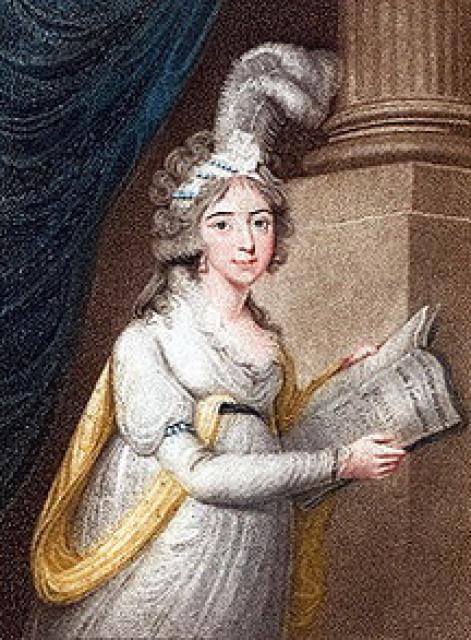
Brigida Banti
 Italy
ItalyEarly Life
The exact details of Brigida Banti's birth are shrouded in mystery. Some sources suggest 1756, while others point to 1758. Cremona and Monticelli d'Ongina near Cremona have both been proposed as her birthplace. Born into a family of street musicians, Banti began her singing career on the streets.
The Road to Stardom
Banti's journey to stardom took a pivotal turn during her travels in Southern Europe in 1777-1778. In Paris, she encountered an influential figure who facilitated her debut at the Opéra-Comique. Subsequently, she traveled to London, where she met the dancer and choreographer Zaccaria Banti, whom she married in Amsterdam in 1779.
Continental Success
After a brief sojourn in Vienna in 1780, Banti returned to Italy and secured an engagement at the Teatro San Benedetto in Venice. Her performances in Bianca's "Pyram and Thisbe," Sarti's "Atoll," and Bertoni's "Orpheus and Eurydice" garnered critical acclaim. She then embarked on tours in Turin, Milan, and Warsaw, performing works by Paisiello, Anfossi, and Guglielmi.
Zenobia and La Fenice
In 1791, Banti created the role of Zenobia in Anfossi's "Zenobia in Palmira," which became one of her most celebrated performances. In 1792, she participated in the opening of Venice's La Fenice theater, performing alongside the renowned castrato Gasparo Pacchierotti in Paisiello's "The Games of Agrigento."
Legacy
Banti's exceptional vocal skills, which she developed without formal musical training, were attributed to her unusually long lungs. Her expressive, temperamentful performances drew comparisons to Pacchierotti. Despite the decline of her vocal abilities later in life, Banti left an enduring mark on the world of opera. Her son, Giuseppe, published a brief biography of her life six decades after her passing.