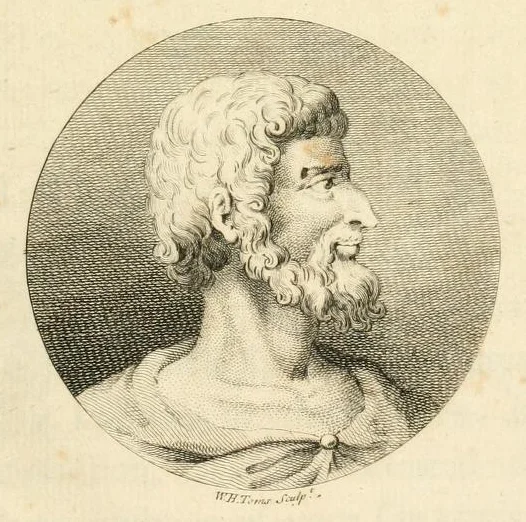
Callimachus
Callimachus turned scholarship into a poetic art. Working in the book-rich world of third-century BCE Alexandria, he retold old myths, investigated the origins of customs and crafted short, intricate poems that prized precision over sheer length. His surviving works are only a fraction of what he wrote, but they shaped Greek literary taste and inspired some of Rome’s most celebrated poets.
From Cyrene to Alexandria
Callimachus was born in Cyrene, a Greek city in what is now Libya, and flourished during the first half of the third century BCE. The details of his life are sparse, and ancient biographies often draw inferences from his poems. He became part of the intellectual community at Alexandria, the Ptolemaic capital whose royal court supported scholarship, poetry and the famous Library.
He is closely associated with the Library, but the familiar claim that he served as its chief librarian is not supported by the evidence. His scholarship is clear in a major work called the Pinakes, or “Tables”: a vast catalogue of Greek literature organized by genre and including information about authors and their works. Although the original has not survived, later writers regarded this project as a landmark in organizing literary knowledge.
Poetry built from learning
Callimachus wrote in many forms, including hymns, epigrams, elegies, iambic poems and short epic narratives. His most ambitious poetic project was the Aetia, meaning “Causes” or “Origins.” In it, he used stories about heroes, local customs, religious rituals and place names to explore why the Greek world did things as it did. Rather than tell one continuous epic, he moved among episodes, turning the past into a series of vivid, learned discoveries.
His poem Hecale offered a miniature epic about the hero Theseus and his encounter with an elderly woman. Its smaller scale allowed for intimate characterization and careful detail. The six surviving hymns combine mythic storytelling with sophisticated allusions, while his short epigrams range from memorials and dedications to reflections on love and loss. Much of his work is now known only through papyrus fragments and quotations preserved by later authors.
Callimachus became associated with a literary preference for polished, compact poetry over long, conventional epics. Ancient reports tell of a feud with Apollonius of Rhodes, author of the Argonautica, but modern scholars question whether the famous rivalry was as personal or dramatic as later accounts suggest. What is unmistakable is the intellectual debate around poetic scale and style in Alexandria, where writers engaged closely with the literary past while experimenting with new forms.
A lasting influence
Roman poets made Callimachus a central model. Catullus adapted his poem on the Lock of Berenice, and Ovid, Propertius and other Latin writers drew on his techniques and themes. His influence extended beyond poetry: the Pinakes helped establish an enduring model for arranging and describing literature.
Only a small portion of Callimachus’ extensive output survives intact, yet that fragmentary legacy still reveals a writer who could make erudition playful and elegant. He treated myth not as a storehouse of familiar tales but as material for discovery, and showed that a brief poem could carry the weight of an entire library.