Carl Nielsen
 Denmark
Biography of Carl Nielsen
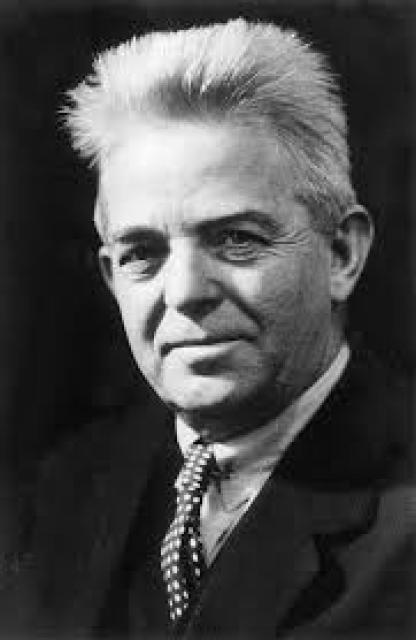
Early Life and Musical TalentCarl August Nielsen, the composer and the leading figure of Danish music, was born on June 9, 1865, in the village of Nørre Lyndelse, Funen, to a poor family. His father, Niels Jørgensen, was a painter and musician who played the violin and cornet. Nielsen often performed at local celebrations. He fondly recalls his mother singing folk songs to him during his childhood. His mother's family had wealthy sea captains in their lineage, and one of his step-uncles was Hans Andersen, a talented musician. At the age of six, Carl received his first musical instrument from his mother. He learned to play the violin and piano, and by the age of eight or nine, he had successfully composed a lullaby and a polka, both of which he mentioned in his autobiography. Despite demonstrating his musical abilities at an early age, his parents did not believe he could achieve fame as a musician and sent him to apprentice under a shopkeeper in a neighboring village. However, the shopkeeper quickly went bankrupt, and Carl returned home. He honed his skills on wind instruments and, on November 1, 1879, became a trumpeter and trombonist in a military band in the nearby city of Odense. Despite his army service, Nielsen continued to play the violin and performed with his father during his visits home. During his military service, Carl received 45 öre and a loaf of bread every five days for two and a half years, after which his salary slightly increased. With this money, he was able to buy civilian clothes necessary for performing at rural festivals with dances. From 1884 to December 1886, Carl studied at the Royal Academy of Music, where he presented his 'Suite for Strings, Op. 1' in 1888, at the age of 23. The following year, Nielsen secured the position of second violinist in the prestigious Danish Royal Orchestra conducted by Johan Svendsen. He remained in the orchestra for 16 years and participated in Danish premieres of Giuseppe Verdi's 'Falstaff' and 'Otello.' Soon after his arrival in Paris in early March 1891, Nielsen met Danish sculptor Anne Marie Carl-Nielsen, nee Brodersen. They traveled to Italy together and married in an Anglican church, St. Mark's, on May 10, 1891, in Florence, Italy. According to musicologist David Fanning, Carl and Anne Marie were not connected by love, but by their intellects. Anne Marie was a talented cultural figure, "a strong and modern person determined to forge her own career." Carl did not like this situation. Brodersen spent months away from home in the 1890s and 1900s, allowing her infatuated husband to court other women. The unhappy spouse had to raise three young children from Anne Marie while fulfilling his duties at the Royal Theatre. Carl had a total of five children, two of whom were born out of wedlock. His son, Carl August, was born in January 1888, before meeting the sculptor. In 1912, the composer had a daughter, Rachel Sigmann, from an extramarital relationship. Brodersen never learned about the existence of this child. In their marriage, they had two daughters and a son. Their eldest daughter, Irmelin, studied music theory with her father and later married Dr. Egert Møller, who became a professor at the University of Copenhagen. Their younger daughter, Anne Marie, graduated from the Royal Danish Academy of Fine Arts and married Hungarian violinist Emil Telmányi. Their son, Hans Børge, became disabled due to meningitis and spent most of his life away from the family. Hans died in 1956. In 1916, Nielsen became a teacher at the Royal Academy of Music, where he worked until his death.

Musical Career and Style
Nielsen's compositions between 1897 and 1904 are sometimes attributed to his "psychological" period, which reflects his troubled marriage with Brodersen. His six symphonies, Wind Quintet, and violin, flute, and clarinet concertos are particularly noteworthy in his body of work. In his early music, Carl drew inspiration from composers such as Brahms and Grieg. However, he quickly developed his own style, initially experimenting with progressive tonality and later deviating even further from the compositional standards prevalent at the time.
Later Life and Legacy
Nielsen's sixth and final symphony, 'Sinfonia Semplice,' was composed between 1924 and 1925. The composer died of a heart attack on October 3, 1931, and was buried at the Vestre Cemetery in Copenhagen. Throughout his life, Nielsen had a reputation as an outsider, both in his own country and internationally. It was only later that his works were included in the international repertoire.

In the late 1940s, two major biographical books about Carl were published in Danish. The first comprehensive study of Nielsen's life in English was written by Robert Simpson. Published in 1952, the book was titled 'Carl Nielsen, Symphonist.'

Since the 1960s, Nielsen's popularity has significantly increased, partly due to the efforts of Leonard Bernstein. In 2006, three of Nielsen's compositions were included by the Danish Ministry of Culture in the list of the "12 greatest works of Danish music." From 1997 to 2010, banknotes worth 100 Danish kroner featuring the composer's image were in circulation.