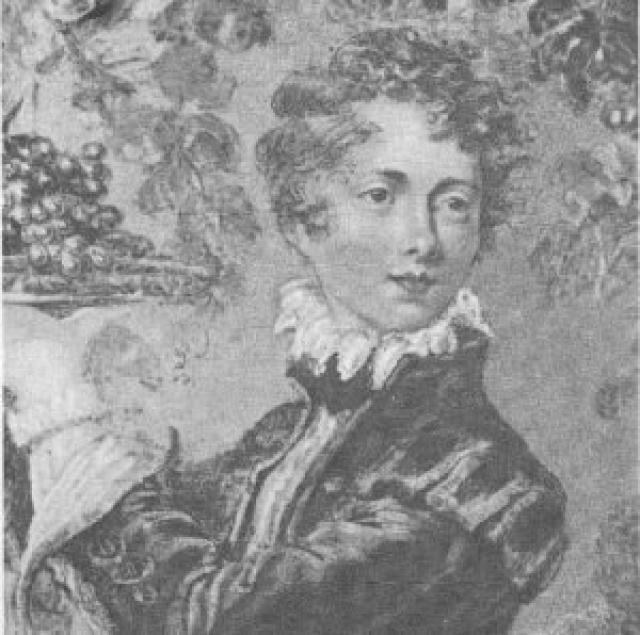
Caroline Lamb
 Great Britain
Caroline Lamb was an Anglo-Irish aristocrat and novelist whose writing was too often overshadowed by her brief, highly publicized affair with the poet Lord Byron. Born into the Whig political elite, she moved through a world of parliamentary families and literary salons, while using fiction to test its rules and expose its hypocrisies. Her first novel, “Glenarvon,” became a Regency sensation and secured her a place in literary history.
Family, Education, and Marriage
Born Caroline Ponsonby on November 13, 1785, she was the daughter of Frederick Ponsonby, later the 3rd Earl of Bessborough, and Henrietta Spencer, sister of Georgiana, Duchess of Devonshire. Her family’s connections brought her into the heart of fashionable Whig society. As a child, she spent time in Europe, where she studied languages and art, though her education was irregular.
In 1805 she married William Lamb, who later became Viscount Melbourne and served as prime minister. Their relationship began as a love match, but family pressures, political life, and grief shaped the marriage. Two infant daughters died, while their son Augustus survived with serious disabilities and required care at home. Caroline was devoted to him. The strain on the household and William’s public career eventually drew the couple apart, though they did not formally separate until 1825.
Byron and “Glenarvon”
Caroline met Byron in 1812, after she had read his poem “Childe Harold’s Pilgrimage.” She described him as “mad, bad, and dangerous to know,” and their passionate affair became the talk of London society. Byron ended the relationship, but Caroline remained attached to him, and her response to the breakup was both personal and literary.
In 1816 she anonymously published “Glenarvon,” a Gothic novel with recognizable portraits of herself, Byron, and other figures from their social circle. The book sold well, yet its unflattering portrayals and open discussion of scandal deepened her estrangement from fashionable society. The novel’s reputation as an act of revenge has sometimes obscured its literary ambition: it blends Gothic melodrama with political tensions and a critique of the expectations placed on women.
Writing and Later Years
Caroline continued to publish after “Glenarvon,” including the novels “Graham Hamilton” and “Ada Reis,” along with poetry and parodies of Byron. She also supported writers and artists, including composer Isaac Nathan. Her later work and her intellectual interests reveal a writer who wanted to be taken seriously, not merely treated as a society figure or a romantic curiosity.
After separating from William, Caroline spent much of her time at Brocket Hall in Hertfordshire. She faced declining health and increasing personal difficulties, but remained connected to writing and literary circles. She died in January 1828, aged 42, with William at her side.
Caroline Lamb’s life illustrates the costs of being an outspoken woman in Regency society, where men’s affairs could become legend while women’s desires were treated as scandal. Her fiction preserved a vivid account of that world, and “Glenarvon” remains one of its most revealing literary portraits.


