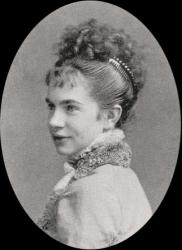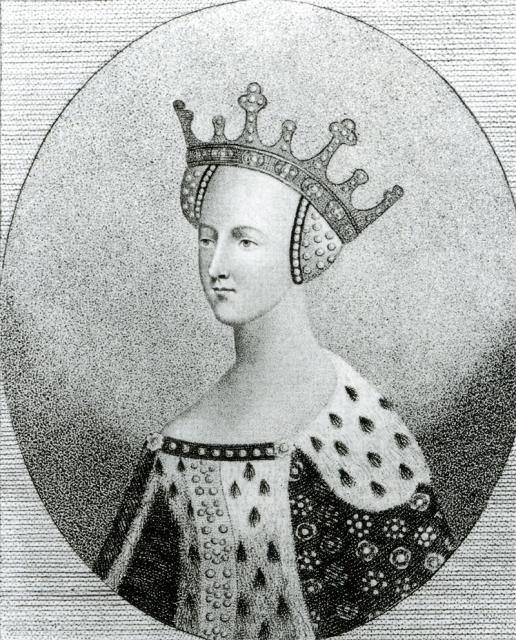
Catherine Valois
 Great Britain
- Early Life and Background
- Marriage Negotiations
- The Treaty of Troyes
- Marriage and Reign as Queen of England
- Birth of Henry VI and Catherine's Regency
Early Life and Background
Catherine of Valois was born in the royal residence of Saint-Pol Palace in Paris, as the youngest daughter of King Charles VI of France and Isabella of Bavaria. Her mother's extravagant lifestyle and alleged neglect of her children have been speculated on, though some argue that these accounts may have been driven by hostile propaganda.
Despite her father's mental illness, Catherine and her siblings were raised under the watchful care of servants. She was later educated at the Abbey of Poissy, where her sister Mary was a nun.
Marriage Negotiations
In 1408, King Henry IV of England proposed a marriage alliance between the royal families of England and France to end the protracted conflict between the two nations. His son and heir, the Prince of Wales, was to wed a French princess. Initially, Isabella, the widow of King Richard II and Catherine's elder sister, was considered as a potential bride. However, Isabella firmly refused, leading to the decision in 1409 that Catherine would become the heir's bride.
Negotiations resumed in 1413, but the English demands proved unacceptable to France. The English ambassador, who arrived in Paris in 1414, demanded a dowry of no less than 2 million gold crowns, as well as Normandy and other French territories once owned by Eleanor of Aquitaine. Charles VI, however, had only 600,000 crowns at his disposal.
The Treaty of Troyes
After the disastrous Battle of Agincourt in 1415, France experienced internal turmoil. Queen Isabella was imprisoned for six months in 1417 by the Armagnac faction. With the help of the Duke of Burgundy, she escaped and resumed negotiations with England for Catherine's marriage to Henry in 1418.
On June 2, 1419, Isabella and the Duke of Burgundy met with King Henry V in Mélun, accompanied by Catherine. Henry was deeply impressed by Catherine's beauty, but he remained firm in his territorial demands. This led to a quarrel with John the Fearless, who turned to the Armagnacs. On September 10, 1419, the Duke of Burgundy was assassinated by the Dauphin's officers.
Isabella accused her son of murder and allied herself with the new Duke of Burgundy, Philip the Good. Further negotiations between the queen and the duke with the English resulted in a preliminary agreement for Catherine's marriage to Henry, which was signed on December 2, 1419, in Arras.
On December 25, 1419, the Treaty of Troyes was signed, establishing an alliance between Philip the Good and Henry V against the Dauphin. Under the treaty, the Dauphin Charles was disinherited, Henry V was recognized as the heir to Charles VI, and their children would inherit the French crown. France would lose its independence and become part of a united kingdom. As Catherine's dowry, France agreed to pay England 40,000 écus annually. Charles VI and Isabella of Bavaria retained their titles as king and queen until their deaths.
Marriage and Reign as Queen of England
On June 2, 1420, Henry V and Catherine were married in the Church of Saint John in Troyes. The war against the Dauphin and the Armagnacs continued. Catherine witnessed the surrender of Sens on June 11, 1420, and later resided with her parents in Brie and Corbeil. Henry, busy with the siege of Meaux, visited his wife only occasionally.
The couple celebrated Christmas 1420 in Paris at the Louvre. The English Parliament urged the king to return to England after his prolonged absence. Henry and Catherine were greeted with great fanfare by their subjects in London on February 21, 1421. Catherine was crowned queen at Westminster Abbey two days later, without Henry's presence at the ceremony.
To introduce Catherine to her subjects and raise funds for the war against the Dauphin, Henry and his queen embarked on a tour of northern England. In May, they returned to Westminster. Henry left England in June to resume his military campaign, while Catherine awaited the birth of their child.
Birth of Henry VI and Catherine's Regency
On December 6, 1421, Catherine gave birth to the heir apparent, the future Henry VI (1421-1471). In 1422, eager to join her husband, Catherine left their infant son and embarked with a force of 20,000 under John of Lancaster, Duke of Bedford, to Harfleur.
On May 26, 1422, the queen reunited with Henry and her parents in Vincennes. Four days later, they all arrived in Paris, where Henry and Catherine celebrated Pentecost with great pomp, inviting Queen Isabella. On June 11, the couple visited the Abbey of Saint-Denis, continuing the festivities in Senlis, where Henry left his wife.
Having fallen ill during the siege of Meaux, Henry's condition worsened, and he died in Vincennes on August 31, 1422. Catherine became regent of England for her infant son, Henry VI. Her brother-in-law, the Duke of Bedford, acted as her advisor and protector of the realm.
Catherine's regency lasted until Henry VI reached the age of 13. She played a modest but influential role in English politics, ensuring the stability of the kingdom during a turbulent period in its history.