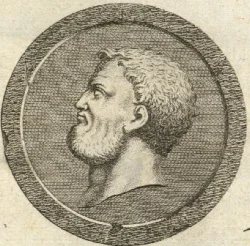
Cem Sultan
Cem Sultan was born into the Ottoman dynasty with the education and expectations of a future ruler. When his father, Mehmed II, died in 1481, Cem challenged his elder half-brother Bayezid for the throne. Defeated in battle, he sought refuge abroad, only to spend the rest of his life passed between European powers that saw his claim as a diplomatic weapon.
A prince and poet
Cem was born in Edirne in December 1459, a son of Mehmed II, the Ottoman conqueror of Constantinople, and Çiçek Hatun. Like other Ottoman princes, he was prepared for government through education and provincial service. He learned Arabic and Persian, studied literature and religion, and developed a lasting interest in poetry. As a young man he governed in Anatolia, including the province centered on Konya, where he built a circle of scholars and poets.
Cem wrote poetry in Turkish and Persian. His Turkish Divan includes lyric poems that later readers connected with longing and separation, themes that took on particular force after his exile. He also translated a Persian romance, Cemşîd ü Hurşîd, into Turkish. His literary work gave him a place in Ottoman cultural history separate from his unsuccessful political career.
The succession struggle
Mehmed II died in May 1481. Ottoman succession did not operate through a fixed rule of eldest-son inheritance, and Cem and Bayezid both had supporters among the military, administrators and provincial elites. Bayezid, the older brother, moved quickly from Amasya, while Cem was based in southern Anatolia.
Cem proclaimed himself sultan at Bursa and briefly established a rival court. He proposed dividing the empire with Bayezid, but his brother rejected the arrangement. Their forces met near Yenişehir, where Cem was defeated. He fled to Mamluk-ruled Egypt, then returned to Anatolia and tried once more to gather support. The second campaign also failed, leaving him with few options beyond seeking protection outside Ottoman territory.
Captive in Europe
In 1482 Cem reached Rhodes and placed himself under the protection of the Knights Hospitaller. He hoped to use the island as a base from which to return to Ottoman lands, but the knights instead kept him in custody and moved him between strongholds in France. His presence was valuable: European rulers could threaten to release a rival who might reignite conflict inside the Ottoman Empire.
Cem’s captivity became a sustained diplomatic contest. Sultan Bayezid II negotiated with the powers holding his brother and paid for his continued detention, while European rulers and the papacy sought to control his movements and political value. In 1489 Cem was transferred to Rome, where Pope Innocent VIII received him. He remained there under papal custody during the pontificate of Alexander VI.
The arrangement shifted again in 1494, when the French king Charles VIII entered Italy and sought to use Cem in his plans for a campaign against the Ottomans. The prince was taken from Rome toward Naples. He died in southern Italy on 25 February 1495, aged thirty-five. The circumstances of his death have prompted later speculation, but claims that he was deliberately poisoned are not securely established. His body was eventually returned to Ottoman territory and buried at Bursa in 1499.
Legacy
Cem never ruled the Ottoman Empire, but his claim shaped the diplomacy of Bayezid II’s early reign. As long as he lived, European governments could treat his presence as leverage, and the Ottoman court had to manage the danger that he might become the center of another revolt. His years of confinement also made him a figure of fascination in Renaissance Europe, where his identity as an Ottoman prince carried both political and cultural weight.
In Ottoman memory, Cem remains both a tragic claimant and a cultivated poet. His Turkish and Persian writings preserve the voice of a prince whose political defeat turned into a life of enforced travel and separation from home. The story of his captivity shows how a succession struggle within one empire became an international affair, with his person and his poetry enduring long after the contest for the throne was over.