Charles Messier
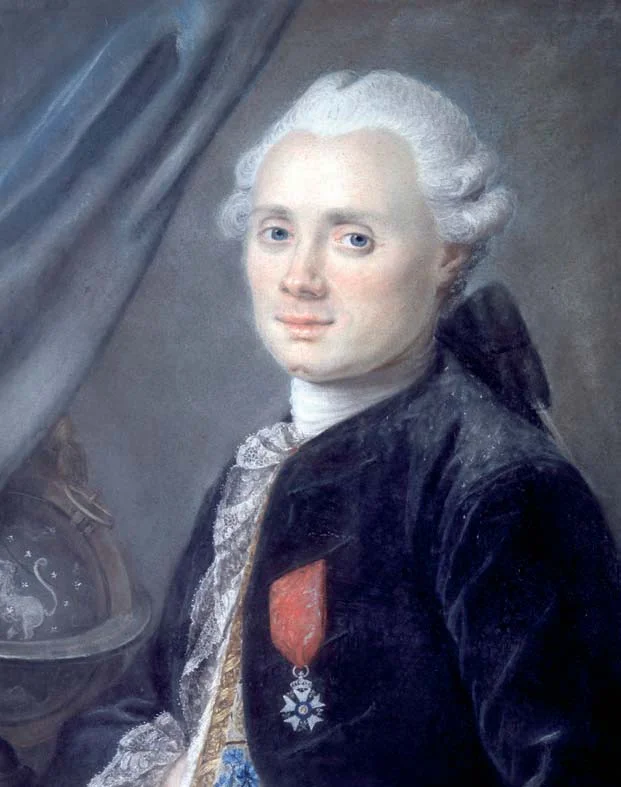
Charles Messier was born on 26 June 1730 in Badonviller, in the Principality of Salm, a territory within the Holy Roman Empire. The tenth of twelve children, he lost his father when he was 11 and had little formal schooling. A dazzling comet that appeared in 1744 captured his imagination and set him on a path toward the night sky.
From Paris clerk to comet hunter
Messier went to Paris in 1751 and became assistant to astronomer Joseph-Nicolas Delisle, recording observations and copying maps. He learned to use astronomical instruments at the French Navy’s observatory and developed a lasting focus on comets.
In 1757, Messier began tracking the predicted return of Halley’s Comet using Delisle’s calculations. Errors in those calculations delayed his search, but he finally observed the comet in January 1759. While looking for moving objects in the sky, he repeatedly encountered fixed, cloudy patches that resembled comets at first glance.
A catalog for avoiding false alarms
Messier started listing these stationary objects so that he and other comet hunters would not mistake them for new comets. The first object he recorded was the Crab Nebula, now called Messier 1 or M1. His “Catalog of Nebulae and Star Clusters” began with 45 entries, grew to 68, and reached 103 by 1781. The modern Messier catalog contains 110 objects, including galaxies, nebulae, and star clusters.
The list was never intended as a showcase of deep-space wonders. It began as a practical tool for comet hunters, but it became one of astronomy’s best-known observing guides. Messier himself discovered more than a dozen comets and earned the nickname “Comet Ferret” from King Louis XV.
Recognition and legacy
Messier became a member of London’s Royal Society in 1764 and the French Académie des Sciences in 1770. In 1771, he was appointed Astronomer of the French Navy. He continued observing for decades, working with fellow astronomer Pierre Méchain on later additions to the catalog.
Napoleon awarded him the Legion of Honour in 1806. After a stroke and declining eyesight curtailed his work, Messier died in Paris in April 1817. His catalog, created to help distinguish comets from their lookalikes, remains an enduring guide for astronomers and skywatchers.