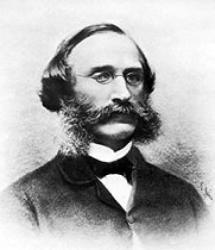
Charles Proteus Steinmetz
 USA
USA- Early Life and Education
- Emigration to the United States
- Electromagnetic Research
- Hysteresis Loss Formula (1890-1892)
- AC Circuit Analysis (1893)
- Contributions at General Electric
- Niagara Falls Hydroelectric Project
- Lightning Studies and Protection
- Electrical Engineering Advances
- Honors and Legacy
Early Life and Education
Charles Proteus Steinmetz was born on April 9, 1865, in Breslau, Germany (now Wrocław, Poland). He attended the University of Breslau and graduated from the Polytechnic University of Zurich.
Emigration to the United States
In 1889, Steinmetz immigrated to the United States. He began working at an electrical engineering firm in Yonkers, New York.
Electromagnetic Research
Under the influence of the company's owner, Rudolf Eickemeyer, Steinmetz developed an interest in electrical engineering. He established a laboratory where he conducted most of his research.
Hysteresis Loss Formula (1890-1892)
Steinmetz's initial focus was on determining power losses in magnetic materials used in electrical equipment. He formulated an empirical equation to calculate hysteresis losses, allowing for their consideration in the design of transformers, electric motors, generators, and other devices.
AC Circuit Analysis (1893)
Steinmetz developed a method for calculating alternating current circuits in 1893. This method was widely adopted in practice, aided by Steinmetz's numerous lectures and his book, "Engineering Mathematics" (1910).
Contributions at General Electric
In 1893, Eickemeyer's company was acquired by General Electric, where Steinmetz was appointed as an engineer. This gave him expanded opportunities for research and innovation.
Niagara Falls Hydroelectric Project
Steinmetz played a major role in the development of powerful generators for the new hydroelectric power plant at Niagara Falls, introducing numerous advancements.
Lightning Studies and Protection
Steinmetz also studied transient disturbances in electrical circuits, investigating the nature of lightning and proposing methods for protecting power lines.
Electrical Engineering Advances
In addition, Steinmetz made contributions to the design and analysis of lighting systems and large electrical machines. He eventually rose to the position of chief consulting engineer at General Electric.
Honors and Legacy
In 1901, Steinmetz was elected president of the American Institute of Electrical Engineers. In 1902, he was appointed professor of electrical engineering at Union College. Steinmetz died in Schenectady, New York, on October 26, 1923. His work has had a lasting impact on the field of electrical engineering.