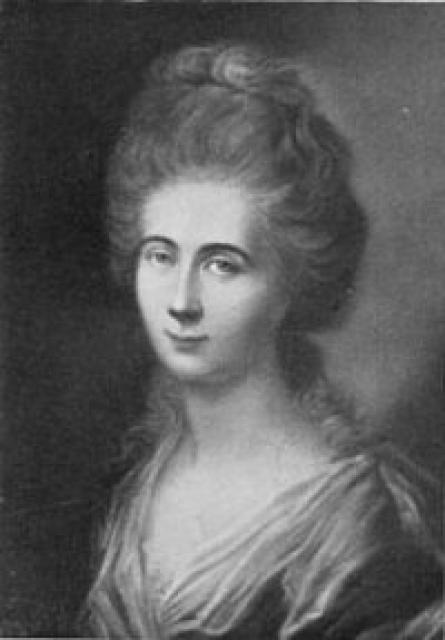
Charlotte Buff
 Germany
- A young woman at the center of a busy household
- The Wetzlar summer and Goethe
- Marriage, family, and later years
- The woman behind the literary legend
Charlotte Buff’s name became famous through Goethe’s The Sorrows of Young Werther, but her life was much larger than the fictional Lotte who bore her likeness. A daughter of a large Wetzlar family, she became the household’s steady center while still young, later raising a family of her own in Hanover. Her brief connection with Goethe became a lasting literary story, even as she built a practical, private life beyond it.
A young woman at the center of a busy household
Charlotte Sophie Henriette Buff was born in Wetzlar on January 11, 1753, the second of 16 children of Heinrich Adam Buff, an official at the Teutonic Order’s local estate, and Magdalena Ernestina Feyler. After her mother died in 1771, Charlotte took on much of the work of caring for the household and her younger siblings. Contemporary descriptions remembered her as open, lively, and warm, qualities that would later be transformed into the celebrated character of Lotte.
In 1768, she became informally engaged to Johann Christian Kestner, a Hanoverian legal official working in Wetzlar. Their relationship was longstanding, though the couple did not marry until 1773.
The Wetzlar summer and Goethe
Buff met the young Johann Wolfgang von Goethe at a dance in June 1772, while he was in Wetzlar working at the Imperial Chamber Court. Goethe became deeply attached to her, but Buff remained committed to Kestner. Goethe left Wetzlar after a few months, and later drew on the emotional triangle of the three young people for his epistolary novel The Sorrows of Young Werther, published in 1774.
The book quickly made the name “Lotte” widely known. The fictional character was not a precise portrait of Buff: literary historians note that Goethe blended details from more than one woman into the role. Kestner also contributed to the story’s background, inspiring the character Albert. In real life, the relationship between the three was more restrained and affectionate than the novel’s tragic plot suggests. Goethe remained in correspondence with the couple after leaving Wetzlar.
Marriage, family, and later years
Buff and Kestner married in Wetzlar on April 4, 1773, and soon moved to Hanover, where Kestner continued his career in public service. They had twelve children. The eldest, Georg, later became an archivist, continuing a family connection to scholarship and public records.
After Kestner’s death in 1800, Buff lived on as a widow while her children grew up and pursued their own lives. In 1816, at about 63, she visited Goethe again in Weimar. Their reunion attracted interest because the old Wetzlar story had become part of literary history, but Buff’s identity had never depended solely on the role she inspired.
The woman behind the literary legend
Buff died in Hanover on January 16, 1828, aged 75. Her enduring place in cultural memory comes from the way Goethe’s novel turned a real encounter into one of European literature’s best-known love stories. Yet her own story is also one of family responsibility, a long marriage, motherhood, and the quiet strength required to manage life in a large household.


