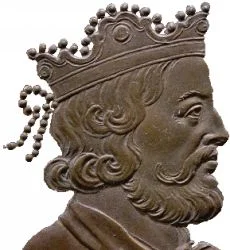
Childebert I
- A kingdom divided among brothers
- Campaigns and Christian patronage
- Family and succession
- A long reign in a turbulent age
Childebert I ruled the Frankish kingdom centered on Paris for nearly five decades, during a formative era when the Merovingian realm was divided among the sons of Clovis I. He extended his influence through campaigns in Gaul and Spain and tied royal power to the Christian identity of his kingdom. His reign was marked by both ambitious diplomacy and the brutal family rivalries that shaped Merovingian politics.
A kingdom divided among brothers
Childebert was one of the four surviving sons of Clovis I, the Frankish ruler who had united much of Gaul under his authority. When Clovis died in 511, the kingdom was divided among his sons. Childebert received Paris and lands stretching across northwestern Gaul, while his brothers ruled other territories. He remained king of Paris until his death in 558 and later gained control of Orléans and part of Burgundy.
The partition did not prevent the brothers from cooperating when their interests aligned. They also competed for territory and influence. After their brother Chlodomer died in 524, Childebert and their younger brother Chlothar arranged the deaths of Chlodomer’s young sons to prevent them from inheriting a share of the kingdom. One of the boys escaped by entering religious life and became known as Saint Cloud. The episode revealed how dynastic survival could take precedence over family ties in the Merovingian court.
Campaigns and Christian patronage
Childebert took part in campaigns to expand Frankish control, including the conquest of Burgundy in the 530s. In 542, he and Chlothar led an expedition into Visigothic Spain and besieged Zaragoza. Gregory of Tours, writing later in the sixth century, relates that the city’s inhabitants processed around its walls carrying a tunic associated with Saint Vincent. Childebert returned to Paris with a relic connected to the saint.
The relic became part of the religious landscape of the capital. Childebert founded a church and monastery dedicated to the Holy Cross and Saint Vincent outside the city walls. The institution later became known as Saint-Germain-des-Prés, one of Paris’s most important religious houses. The foundation expressed the growing role of Christianity in royal authority and civic life.
Family and succession
Childebert was the son of Clovis and Queen Clotilde, whose Christian faith and influence were remembered across the Frankish world. He had no surviving sons to inherit his kingdom. When he died in 558, his brother Chlothar reunited the Frankish territories under one ruler, ending the division that had followed Clovis’s death.
A long reign in a turbulent age
Childebert’s rule combined territorial expansion, religious patronage and the hard calculations of dynastic politics. His campaigns strengthened Frankish influence, while his foundation for Saint Vincent’s relic left a lasting mark on Paris. The kingdom he ruled was never a stable, centralized state in the later sense, but his reign helped shape the political and religious character of early medieval Gaul.




