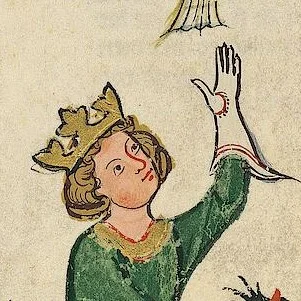
Conradin
Conradin was the last direct male heir of the Hohenstaufen dynasty, a powerful medieval family whose rulers had fought with the papacy for influence in Italy and the German lands. Though still a teenager, he inherited claims to the crowns of Sicily and Jerusalem and the duchy of Swabia. His attempt to recover the Sicilian kingdom ended in defeat and execution, turning his short life into one of medieval Europe’s most enduring dynastic tragedies.
A prince raised in a contested inheritance
Born at Wolfstein Castle in Bavaria on 25 March 1252, Conradin was the son of Conrad IV, king of Germany and Sicily, and Elisabeth of Bavaria. His father died in 1254, before the two had met. Conradin was raised first by his Bavarian grandfather and then by his uncles, who acted as guardians and defended his rights in Swabia. His mother remarried in 1259, and the sources suggest that she had little contact with him afterward.
Conradin inherited grand titles, but they did not translate into settled power. He was recognized as Duke of Swabia, while his claim to Sicily was disputed by the papacy and rival rulers. The title of King of Jerusalem was likewise largely nominal. At ten, he was formally taken to Swabia to assert his rule there. Medieval accounts remember him as handsome and fluent in Latin, and he was associated with courtly poetry as well as arms. At fourteen, he was betrothed, although the identity of his intended bride is uncertain.
The campaign for Sicily
After Conradin’s uncle Manfred was killed fighting Charles of Anjou in 1266, supporters of the Hohenstaufen cause looked to the young heir to reclaim Sicily. In 1267 Conradin crossed the Alps with an army, backed by German nobles and Italian cities. The campaign was expensive and slow: in Verona, his forces ran short of money, and some men sold their horses and weapons to return home. His guardians advised him to abandon the venture, but he continued south with support from allies including Pisa and Siena.
Conradin entered Rome in July 1268 and then advanced toward the Kingdom of Sicily. At Tagliacozzo on 23 August, Charles of Anjou’s forces defeated his army. Conradin escaped the battlefield with a small group but was captured near the coast at Torre Astura and handed over to Charles. The young claimant and several of his companions were taken to Naples.
Execution and remembrance
On 29 October 1268, Conradin was publicly beheaded in Naples. His execution extinguished the direct male line of the Hohenstaufen and shocked contemporaries. His remains were later buried in the church of Santa Maria del Carmine in Naples, where a monument was erected centuries afterward.
The political meaning of his defeat extended beyond one family: the Angevin dynasty consolidated its rule in southern Italy, while the Bavarian dukes acquired much of the Hohenstaufen inheritance through prior agreements. In later centuries, Conradin became a romantic symbol of youth, lost inheritance, and dynastic collapse. His story still carries that dramatic force, even as historians emphasize that his Italian campaign was a serious political project, not simply a reckless adventure by a boy.