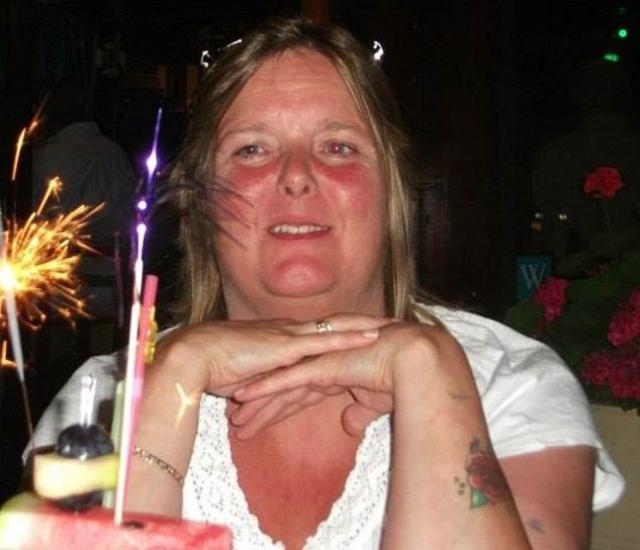
Corinne Little-Williams
 Great Britain
- An Unexpected Souvenir
- Misdiagnosed and Desperate
- A Cancer Scare
- Parasites in the Voicebox
- 9 Years of Dormancy
- A Deadly Risk
- A Life-Saving Medication
- A Slow Recovery
- Lessons Learned
- Understanding the Disease
- Prevention and Treatment
A Near-Fatal Discovery: A British Woman's Ordeal with Cutaneous Mucocutaneous Leishmaniasis

An Unexpected Souvenir
Corinne, a 54-year-old woman from Tiverton, Devon, found herself facing a terrifying ordeal nine years after an innocuous mosquito bite. What started as a sore throat evolved into a life-threatening medical condition, leaving her with a haunting realization.

Misdiagnosed and Desperate
Initially dismissed as a common cold, Corinne's symptoms grew increasingly alarming, including choking on turkey and difficulty swallowing. Despite seeing her doctor and a specialist, a diagnosis remained elusive.
A Cancer Scare
In January 2016, an examination revealed "mangled" vocal cords, raising the possibility of cancer. After a biopsy, Corinne was devastated, but a glimmer of hope emerged when the results were negative.
Parasites in the Voicebox
To her shock, the true culprit was discovered: parasites had invaded her vocal cords, causing cutaneous mucocutaneous leishmaniasis (espudia). Corinne had contracted the disease from a mosquito bite, but had no recollection of any sores or bites.
9 Years of Dormancy
A trip to the tropical disease clinic in London led Corinne to Dr. Diana Lockwood, an expert in espudia. Dr. Lockwood explained that the disease typically manifests as a sore or ulcer, but in Corinne's case, there were none.
Recalling any "bumps or lumps" in recent years, Corinne remembered a trip to Zakynthos, Greece, in 2007, where she had suffered numerous mosquito bites, including one on her leg that swelled abnormally.
A Deadly Risk
Unbeknownst to her, that mosquito carried the parasite. It had lain dormant inside her for nine years, a terrifying realization that magnified the gravity of her situation. Dr. Lockwood warned that without treatment, she could have died within six months.
A Life-Saving Medication
Corinne was prescribed miltefosine, a 30-day course of medication that would eradicate the parasites. While it caused nausea, it ultimately saved her life. After the treatment, her voice began to recover, and her periods returned, which she had previously attributed to menopause.
A Slow Recovery
Four months later, Corinne's voice has regained 80% of its function, with only occasional coughing. She remains under observation, as there is a small chance of relapse.
Lessons Learned
Corinne's experience has been a living nightmare, from the choking episodes to the debilitating nausea from miltefosine. It has also left her with an unwavering aversion to foreign travel.
Understanding the Disease
Dr. Lockwood explained that in Corinne's case, the disease spread to her nose, throat, and vocal cords, causing nosebleeds, nasal congestion, and breathing and swallowing difficulties. The parasites likely entered her bloodstream through the mosquito bite on her leg and remained dormant in her cells for some time.
Corinne's use of steroid inhalers for asthma weakened her immune system in the area of her vocal cords, allowing the parasite to become active and multiply. Left untreated, cutaneous mucocutaneous leishmaniasis can lead to destruction of the vocal cords and trachea, resulting in life-threatening inflammation and suffocation.
Prevention and Treatment
While not all mosquitoes carry the parasite, it is essential to protect oneself from insect bites when traveling to high-risk areas. Visceral and cutaneous mucocutaneous leishmaniasis affect 1.5 million people annually, primarily in South America, Africa, and India, with occasional cases reported in the Mediterranean region, particularly Greece and Spain.
Corinne's case was an unfortunate stroke of bad luck. Thousands of people who use inhalers travel to Greece and Spain each year without developing cutaneous mucocutaneous leishmaniasis. However, the risk, though small, serves as a reminder to be vigilant in protecting oneself from mosquito bites.




