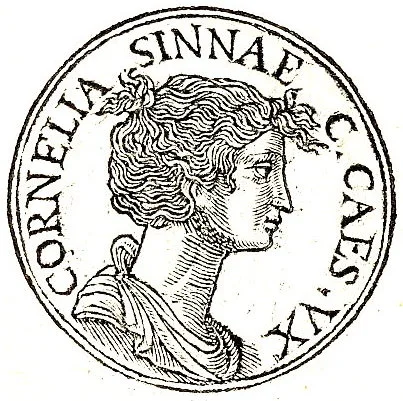
Cornelia
Cornelia was a Roman noblewoman whose brief life intersected with one of the Republic’s most dangerous political struggles. She is remembered chiefly as the daughter of the powerful consul Lucius Cornelius Cinna, the first wife of Julius Caesar and the mother of their daughter Julia. Ancient accounts preserve few details about Cornelia herself, but the episode that made her famous shows how marriage could carry both political meaning and personal risk in late Republican Rome.
Family and Marriage
Cornelia was a daughter of Lucius Cornelius Cinna, a leading figure in Rome during the civil conflicts of the 80s BCE. In about 84 BCE, she married the young Gaius Julius Caesar. Their union linked two patrician families and connected Caesar to the political circle of Cinna and Cinna’s ally, Gaius Marius. It also suited Caesar’s prospects for the prestigious priesthood of Jupiter, which required its holder to meet demanding religious and marital rules.
The marriage soon became entangled in the struggle between Cinna’s faction and Lucius Cornelius Sulla. After Sulla defeated his opponents and took control of Rome, he ordered Caesar to divorce Cornelia. Caesar refused. The ancient biographers Plutarch and Suetonius both recount this act of defiance, though they wrote generations after the events. Suetonius says that Sulla punished Caesar by stripping him of his priestly office and confiscating Cornelia’s dowry and Caesar’s family property. Caesar was forced into hiding and eventually left Italy.
The story places Cornelia at the center of a consequential choice, even though the surviving accounts tell us little about her own thoughts or actions. Caesar’s refusal to abandon her was remembered as an early sign of his resistance to Sulla, and as a decision that tied his fortunes to the political world of Cinna and Marius. The sources describe the dowry as lost, but do not provide a fuller account of Cornelia’s private circumstances during Caesar’s exile.
Motherhood and Later Life
Cornelia and Caesar had one known child, Julia, born in the 70s BCE. Julia later married Pompey the Great, creating a family alliance that helped bind Pompey and Caesar together politically before their relationship broke down. Through Julia, Cornelia became part of the family story that shaped the final decades of the Roman Republic.
The ancient record suggests that Cornelia died relatively young, around 69 BCE, although exact dates for her birth and death are uncertain. Suetonius reports that Caesar delivered a public funeral speech in her honor, an unusual gesture for a young woman at the time. He also says that Caesar praised the ancestry of his great-aunt Julia at a separate funeral; the two women’s deaths are often discussed together in accounts of his early public career.
A Life Recalled Through Others
No writings by Cornelia survive, and almost everything known about her comes through accounts centered on Caesar. Plutarch’s version emphasizes that Sulla could not persuade or threaten Caesar into divorcing her; Suetonius adds the confiscation of her dowry, their daughter Julia and Caesar’s funeral eulogy. These reports cannot recover Cornelia’s own voice, but they preserve her importance in the political and family history of Rome.
Cornelia’s legacy is therefore both intimate and public. Her marriage linked Caesar to a major faction during a period of civil conflict, and her daughter later became a key figure in Roman elite politics. Through a handful of ancient testimonies, Cornelia remains a reminder that women in Rome could shape dynastic alliances and political loyalties even when the written record left their own lives largely in shadow.