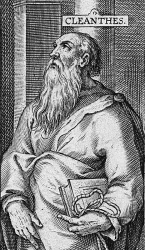
Cratylus
Cratylus left almost no conventional biography, yet his name became attached to two enduring philosophical questions: does reality constantly change, and do words fit the things they name by nature or by human agreement? A late fifth-century BCE Athenian thinker associated with Heraclitus, he is known chiefly through Plato’s dialogue that bears his name and through Aristotle’s account of Plato’s early education.
A Philosopher in Athens
The details of Cratylus’s birth, family, and public life are unknown. He was active in Athens in the second half of the fifth century BCE, when philosophers were debating how people could know a world that appeared to change. His surviving presence is indirect: later writers remembered him as a follower of Heraclitus, the earlier thinker associated with the idea that the world is in continual flux.
Aristotle says that Plato encountered Cratylus when he was young and learned from him the doctrine that sensible things are always changing. Aristotle’s account makes Cratylus one of Plato’s early intellectual influences, before Plato developed the philosophy for which he became famous. It is difficult to reconstruct exactly what Cratylus taught, because none of his own writings survive.
The Dialogue About Names
Cratylus is best known as one of the two speakers in Plato’s dialogue Cratylus. There, he argues with Hermogenes about whether names are correct by nature or simply by convention. Hermogenes maintains that a name works because a community agrees to use it. Cratylus takes the more radical naturalist position: a name is genuinely correct because it reflects the nature of the thing it names.
The dialogue’s title character is also linked to the doctrine of universal change. If everything is in flux, stable knowledge becomes difficult: by the time someone names or describes an object, it may already have changed. Plato stages this problem through a debate about language, asking whether names can reveal reality or whether they are unreliable guides to it.
Plato’s Socrates puts Cratylus’s position under pressure. He offers a long series of playful and often questionable word derivations, then argues that names can mislead and that people must study things themselves rather than trust words as perfect copies. The result is not a simple endorsement of either side. Plato uses Cratylus and Hermogenes to test competing theories, while letting Socrates expose the weaknesses of both.
A Radical Heraclitean
Later philosophical tradition gave Cratylus an especially extreme version of Heraclitean flux. The familiar saying that one cannot step into the same river twice is associated with Heraclitus, but ancient reports say Cratylus pushed the thought further, suggesting that one could not even step into it once, since the river and the person are already changing. Details of the story vary, and it survives as a report about his philosophy rather than a text written by Cratylus himself.
That radical view has made Cratylus a striking figure in discussions of knowledge. If the sensible world never stays still, then naming it may seem futile—and any statement about it risks becoming outdated as soon as it is spoken. The problem anticipates questions that later philosophers would continue to ask about language, identity, and change.
A Legacy Through Other Thinkers
Cratylus’s influence is hard to measure because the evidence is sparse and mediated by Plato and Aristotle. Still, the two accounts suggest that his ideas mattered in the intellectual world that shaped Plato. Plato’s dialogue preserves his challenge to conventional language, while Aristotle’s report places him in the young philosopher’s formative years.
The historical Cratylus remains partly hidden behind the literary character. What survives is enough to show a provocative thinker who pushed the implications of change to their limit and treated language as a clue to the structure of reality. His biography may be elusive, but the questions attached to his name remain remarkably alive.