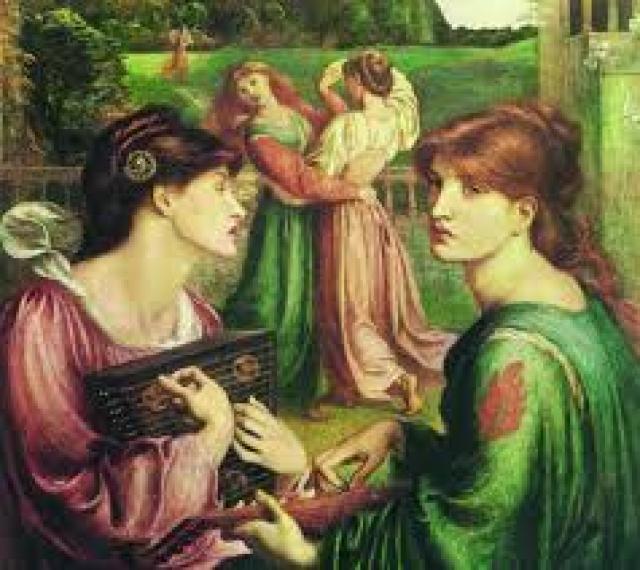
Cunizza da Romano
 Italy
- Family and political marriage
- A story carried by chronicles
- Life after the da Romano collapse
- Dante’s unexpected portrait
Born around 1198 into one of the most powerful families of northeastern Italy, Cunizza da Romano lived through a period when marriage, romance, and political rivalry could become parts of the same public drama. Her name survives in chronicles and troubadour lore as that of a woman swept through several love affairs, but the best-known literary image of her is more surprising: Dante placed her among the blessed in the heaven of Venus in the Divine Comedy.
Family and political marriage
Cunizza was the youngest child of Ezzelino II da Romano, known as “the Monk,” and Adelaide of the Tuscan Alberti family of Mangona. Her brothers included Ezzelino III, a formidable political and military leader, and Alberico, who later ruled Treviso. The family’s power rested on lands and alliances across the Treviso March, a region riven by shifting allegiances among city factions and noble houses.
The first reliable record of Cunizza is her marriage in 1222 to Rizzardo da San Bonifacio, a leading Veronese count. It formed part of a wider political arrangement: at roughly the same time, Rizzardo’s sister Zilia married Cunizza’s brother Ezzelino III. The matches were meant to bring the rival families closer and strengthen the da Romano position in Verona. Instead, local factional conflict soon reignited. Verona’s San Bonifacio family supported one political camp, while the da Romano aligned with its opponents.
A story carried by chronicles
The most famous episode in Cunizza’s life is her departure from Rizzardo’s household with the troubadour Sordello da Goito. Medieval accounts disagree about what happened and why. Some portray an elopement, while the Padua chronicler Rolandino and two Provençal biographies of Sordello suggest that Cunizza’s brothers may have arranged or accepted her removal as a political insult to Rizzardo—or as a way of protecting her amid renewed conflict. Scholars also disagree about the date, placing it between 1222 and 1226.
The evidence does not let us confidently separate private feeling from political strategy. Sordello’s songs and the sharp, teasing exchanges of other troubadours helped turn the episode into a celebrated courtly scandal. Those literary references suggest that Cunizza became a figure of public fascination, but they are not a straightforward record of her private life.
Later chronicles tell of another relationship, with a Trevisan knight called Bonio, and of travel together through many lands. Rolandino says they returned to Treviso when Cunizza’s brother Alberico controlled the city, probably after 1239. Bonio later died fighting Ezzelino’s forces during the conflict between the brothers. These dramatic details come chiefly from a chronicle written decades after the earliest events, so they should be read as medieval testimony rather than as a complete, independently verified biography.
The same account says Ezzelino arranged a later marriage for Cunizza to Naimerio of the Vicentine Breganze family. Rolandino mentions yet another marriage to a Veronese after Ezzelino’s death in 1259, but modern historians consider that late union doubtful. The surviving documents leave much of her later personal life unknown.
Life after the da Romano collapse
The family’s fortunes broke sharply at the end of the 1250s. Ezzelino was captured and died in 1259; in 1260 Alberico and his family were killed after their stronghold at San Zenone was taken. Cunizza’s movements in this crisis are not recorded in detail. She probably found shelter among her mother’s relatives in Tuscany, where the last two known documents bearing her name were made.
In Florence on April 1, 1265, Cunizza issued an act granting freedom to the family’s household dependents. Pope Alexander IV had already issued a measure concerning the da Romano dependents in 1258, so her act may have had little practical legal force. A modern biographical study interprets it instead as a forceful assertion of the surviving family’s identity and rights after its political defeat.
In June 1279, Cunizza made a donation of property claims once associated with her brothers to Alessandro, a relative of the Alberti family. Those claims could no longer restore the family’s former possessions, which northern Italian cities had confiscated and redistributed. This document is the final known record of her life; she died sometime afterward.
Dante’s unexpected portrait
Cunizza’s literary legacy reaches far beyond the chronicles. In *Paradiso*, the final part of Dante’s Divine Comedy, she appears in the heaven of Venus, among souls whose lives were marked by love. She identifies herself and turns quickly from her own story to condemn the violence and factional strife of the region between the Tagliamento and Adige rivers. Dante gives her a voice that sees earthly political cruelty with clarity, even as she speaks from the serenity of heaven.
Her place there contrasts with the sensational reputation built around her romantic adventures. Dante’s scene does not offer a full account of her past or explain her salvation; it uses her regional knowledge and moral authority to cast judgment on the conflicts of her homeland. That tension—between a hard-to-recover historical woman, the vivid legend woven around her, and the luminous figure in Dante—has kept Cunizza compelling for centuries.