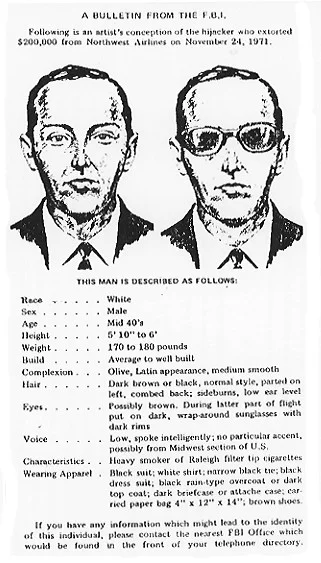
D. B. Cooper
D. B. Cooper is the name attached to one of the most famous unsolved crimes in American history. The hijacker used the name Dan Cooper, seized control of a commercial flight in 1971, collected a ransom, and vanished after jumping from the aircraft by parachute. His real identity and ultimate fate remain unknown.
The Hijacking of Flight 305
On 24 November 1971, a man calling himself Dan Cooper bought a one-way ticket in Portland, Oregon, for Northwest Orient Airlines Flight 305 to Seattle. Shortly after takeoff, he handed a flight attendant a note saying that he had a bomb in his briefcase. He demanded $200,000 and four parachutes.
The aircraft landed in Seattle, where the passengers were released after the ransom and parachutes were delivered. Cooper ordered the crew to continue toward Mexico City, with a refueling stop in Reno, Nevada. During the nighttime flight, somewhere between Seattle and Reno, he lowered the aircraft’s rear stairs and jumped into the darkness with the money. The plane landed safely, but Cooper was gone.
The name D. B. Cooper arose from an early reporting error. The hijacker had identified himself as Dan Cooper, but the mistaken version became the name known to the public. The surviving ticket and FBI records use Dan Cooper, an alias that revealed nothing about the passenger’s actual identity.
A Long Investigation
The FBI opened an investigation, known as NORJAK, while the hijacking was still in progress. Agents interviewed witnesses, examined evidence, searched a wide area, and pursued leads for decades. The case attracted enormous public attention, prompting many theories and proposed suspects, but no one was conclusively identified as the hijacker.
In 1980, a boy named Brian Ingram found $5,800 of the ransom money on a sandbar along the Columbia River in Washington. The bills were identified by their serial numbers as part of the ransom. The discovery offered a tangible clue, but it did not establish where Cooper had landed or what happened to him. Most of the money was never recovered.
Cooper’s survival has also remained uncertain. The jump was made at night in poor weather, over rugged terrain, with equipment that may not have been suited to a controlled descent. These conditions led investigators to consider that he might not have survived, but no remains or conclusive evidence have settled the question.
Legacy of an Unsolved Crime
In July 2016, after an extensive investigation lasting forty-five years, the FBI redirected its resources to other priorities. The bureau said it would preserve evidence and consider specific new physical evidence related to the parachutes or ransom, but it would no longer actively investigate the case.
The hijacking had a lasting impact on aviation security and public imagination. Cooper’s plan exploited features of the Boeing 727, including its rear stairs, and later flight procedures were changed to prevent similar escapes. Yet the central mysteries remain: who the hijacker was, where he jumped, and whether he lived. “D. B. Cooper” is therefore not a known biography so much as the enduring public name of an unidentified man who disappeared into the night.