Dauletkerey Shigaev
 Kazakhstan
- Biography of Dauletkerei Shigaev
- Early Compositions
- Mature Period and Influences
- Later Years and Legacy
Biography of Dauletkerei Shigaev
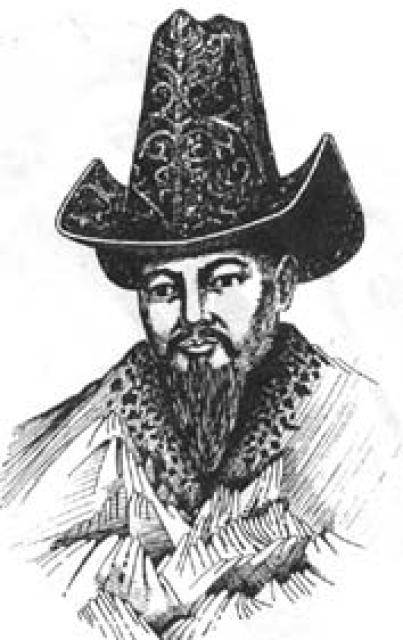
Dauletkerei Shigaev, a renowned Kazakh folk composer of the 19th century, left a significant musical legacy that influenced the further development of instrumental folk music in Kazakhstan. He was born in 1820 on the shores of the Caspian Sea. His father, Sultan Shigai Nuraliev, passed away when Dauletkerei was five years old, and his upbringing was taken over by his cousin, Sultan Mendigirei Bukaykhanov, the wealthiest and most influential person in the Bukay Horde after Khan Jangir.
Dauletkerei was greatly influenced by the kuyshi Musrali, a magnificent master who taught him the technical techniques of playing the dombra, introduced him to the rich folk instrumental music, and encouraged him to pursue independent music making. His acquaintance with European music also played a significant role in shaping the musician. Due to his affiliation with the sultanate and his kinship with Khan Jangir, Dauletkerei often had to visit the Khan's residence. The Khan's court was a unique blend of Eastern customs and etiquette norms of European nobility. There, one could hear the singing and playing of Kazakh folk musicians alongside the refined French language, interspersed with Russian, to the sounds of the extraordinary European instrument - the piano. Dauletkerei also knew Russian folk music and Russian folk instruments. According to his contemporaries, by the age of twenty, Dauletkerei was an excellent dombra player, popular throughout the Bukay Horde. Additionally, he played the Russian balalaika proficiently and had a collection of them.
Early Compositions
In the early 1840s, Dauletkerei composed his first kuyi, "Kyz Akzhelem" and "Kos-Alka". These pieces were inspired by personal experiences. In the case of "Kyz Akzhelem," it was inspired by a meeting with a skilled dombra player and a beautiful girl named Akbala-kyz. The kuyi "Kos-Alka" ("Pair of Earrings") depicts the poetic image of a girl whose earrings gently jingle as she walks. Both kuyis are lyrical pieces filled with a bright and joyful mood.
However, during this period, the composer began to reflect more on the meaning of events, and his compositions started incorporating social motives. This led to the creation of the kuyi "Kara-Kozha," in which Dauletkerei strongly condemns one of the rulers of the Horde, Karaul-Khodzhu, who had a bad reputation for his cruelty and greed. In the kuyis composed after "Kos-Alka," "Kyz Akzhelem," and "Kara-Kozha," Dauletkerei aimed to convey the world of thoughts, moods, and emotions of individuals, rather than focusing solely on representational elements. He worked extensively to expand and enrich the expressive techniques of dombra playing, using genres and features of vocal music and skillfully applying the play on both strings to achieve tonal diversity.
Mature Period and Influences
Dauletkerei's next two works, "Konyr-Kuy" and "Kos Shek," created during his search for new means of expression, were innovative. "Konyr-Kuy" was described as an elegy by Zataevich, who characterized these two kuyis as follows: "Two pieces, with their agitated and pathetic beginnings somewhat emphasized in their content, like shimmering beyond the typical Kazakh instrumental melody and its development. Can this be partly explained by the fact that the author of these kuyis, Sultan Dav-let-girei, due to his position and education, could have and probably did have some knowledge of the music that had developed in different conditions and among a different people?" Dauletkerei worked extensively to expand the artistic possibilities of dombra. An interesting attempt to reinterpret traditional forms of dombra music was the kuyi "Zhelderme." It is a lyrical piece that introduces song-like intonations to enrich the content of dombra music and flexible rhythms to depict the rich and ever-changing world of human emotions, showcasing beauty and poeticism.
In 1851, Dauletkerei Shigaev became the ruler of the Serkesh clan. In the 1850s, he formed close relationships with members of the Russian administration. His friendship with the Chairman of the Temporary Council, G.V. Vashchenko, was particularly close, as Vashchenko helped Dauletkerei to better understand Russian culture and language and introduced him to the circle of Russian intelligentsia. A significant event in his life was his trip to St. Petersburg in the autumn of 1859. The Kazakh delegation traveled to the capital of Russia "to familiarize themselves with the power and splendor of the empire." They stopped in Nizhny Novgorod and Moscow on their way to St. Petersburg. The delegation visited notable landmarks, museums, and witnessed the famous Nizhny Novgorod Fair. They also attended court festivities at the Winter Palace. Most importantly, the guests attended theatrical performances, with Dauletkerei being particularly interested in Moscow, where he had the opportunity to acquaint himself with opera and ballet at the Bolshoi Theatre. During their travels through Central Russia, he heard many Russian songs, and the intonations of these songs can be clearly felt in several of his works. The trip to St. Petersburg played a decisive role in shaping the composer's worldview. Upon returning home, Dauletkerei became a fervent supporter of closer ties between Kazakhstan and Russia, and their cultures.
Later Years and Legacy
In the last three decades of his life, Dauletkerei experienced a true flourishing of his creativity. These were the years of mature thoughts and emotions, during which he produced one masterpiece after another, showcasing mastery and depth of content. The musical impressions from his trip to St. Petersburg found creative expression in several kuyis, where echoes of Russian folk music - the folk song, dance, and march - can be easily traced. Such kuyis include "Vashchenko," dedicated to his friend, as well as "Sholtak" and "Kosagaly." Kuyis like "Topan," "Tundyrma," and "Bayzhuma" can be considered lyrical reflections on the meaning of life and its fleeting nature. In the late 1860s, Dauletkerei had a meeting with Kurmangazy, another prominent Kazakh musical talent. A.K. Zhubanov poetically referred to this meeting of the two great folk musicians as a "kuy fair." During the encounter, Dauletkerei played his kuyi "Bulbul" ("Nightingale"). The piece greatly impressed Kurmangazy, who incorporated it into his repertoire and even composed a paraphrase on this theme. It would be inaccurate to claim that the kuyi "Bulbul" only portrays the image of a nightingale and its carefree singing. Zataevich noted that the main focus of this work is the depiction of the beauty of a southern night and the images of southern nature. He described it as a piece of extraordinary poetry and imagery, filled with flashes of temperament and an intoxication with the beauty of the southern night, "nightingale-like" without empty imitations. It is a composition saturated with stirring content, much like a tale of Scheherazade waiting for her Rimsky-Korsakov... It reflects the emotional experiences of a lost folk musician in the vast steppe!
Playing for each other, Kurmangazy and Dauletkerei borrowed from one another extensively. Zataevich wrote: "I believe that any musician who becomes acquainted with this incredible piece must acknowledge that in this case, the modest dombra is entrusted and limited to music of exceptional depth, pathos, and significance." The kuyi "Zhiger" was created during a period of intense emotional crisis. The death of a close friend and relative, Muhammad Salikh Babadzhanov, the final rupture with his social class, the poverty he fell into in his later years, the difficult situation of the people whom the composer sought to help through his humane rule, and at the same time, the alienation of the common people who saw Dauletkerei as a representative of the ruling elite - all of this instilled a sense of bitterness and tragic dissonance with reality in the composer.
As a result of all these complex experiences, emotions, and reflections, a tragic worldview emerged, which found artistic expression in the kuyi "Zhiger" - a work of tremendous tragic power and excitement that conveyed the restless spirit of its time.
Dauletkerei passed away between April 21 and May 4, 1887. He left a significant musical legacy that influenced the further development of instrumental folk music in Kazakhstan.