David Cherny
 Czech
Czech- David Černý - A Provocative and Controversial Czech Sculptor
- Early Life and Education
- The Pink Tank Incident
- Notable Works
David Černý - A Provocative and Controversial Czech Sculptor
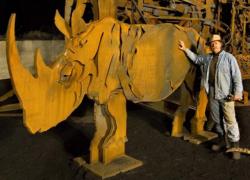
David Černý is widely recognized as one of the most prominent contemporary Czech sculptors known for his provocative and controversial works that combine humor, provocation, social and political satire. While his pieces have often received sharp criticism from the public, several of his works installed in Prague have gained widespread recognition and have become prominent landmarks in the Czech capital.
Early Life and Education
David Černý was born on December 15, 1967, in Prague, into a Jewish family. In 1996, he graduated from the Prague Academy of Arts, Architecture, and Design.
The Pink Tank Incident
Černý gained significant public attention with his first notable work, "The Pink Tank," in 1991. He painted a Soviet IS-2 tank, located in Kinský Square in Prague's Smíchov district, pink as a way to ridicule the symbolism of Soviet military monuments, which were perceived by many as a threat to peaceful populations. The tank was also adorned with a giant finger in the shape of a phallic gesture. Although this action was intended to challenge the perception of the tank as a symbol of liberation, it was widely seen as an insult to the memory of the Soviet soldiers who liberated Czechoslovakia in 1945. Černý was arrested for hooliganism, and after protests from the Russian government, the tank was returned to its original state.
Notable Works
Despite the controversy surrounding his art, Černý's works continue to attract attention. Some of his most renowned pieces include:
- "The Horse" (1999): A sculpture depicting Saint Wenceslas sitting on the belly of his dead horse, mocking the reverence with which the famous statue by Josef Myslbek on Wenceslas Square is perceived by the people of Prague. Originally located at the lower end of Wenceslas Square, it is currently displayed in the "Lucerna" passage on Vodičkova Street.
- Giant Crawling Babies: A series of sculptures featuring oversized crawling babies climbing the Prague Television Tower in Žižkov. This installation transformed the television tower into one of Prague's most popular tourist attractions.
- "Shark" (2005): This work depicted a figure representing Saddam Hussein partially submerged in a yellow-green formaldehyde solution in a glass aquarium. It won a special prize at the Prague Biennale 2005 and was a parody of Damien Hirst's famous artwork "The Physical Impossibility of Death in the Mind of Someone Living." The installation was banned in Middlekerke, Belgium, and Bělsko-Biała, Poland.
- Other notable installations include "Babies" (1990), "Quo vadis" (1990), "In God We Trust" (1991), "Bone" (1990), "The Day of Murders" (1992), "Man Hanging Out" (2017), and "Entropy" (2009), a satirical representation of common stereotypes about European countries.
David Černý's unique and controversial approach to sculpture has established him as one of the most prominent and influential artists in the Czech Republic. His works continue to challenge societal norms and provoke discussions on various social, political, and cultural issues.