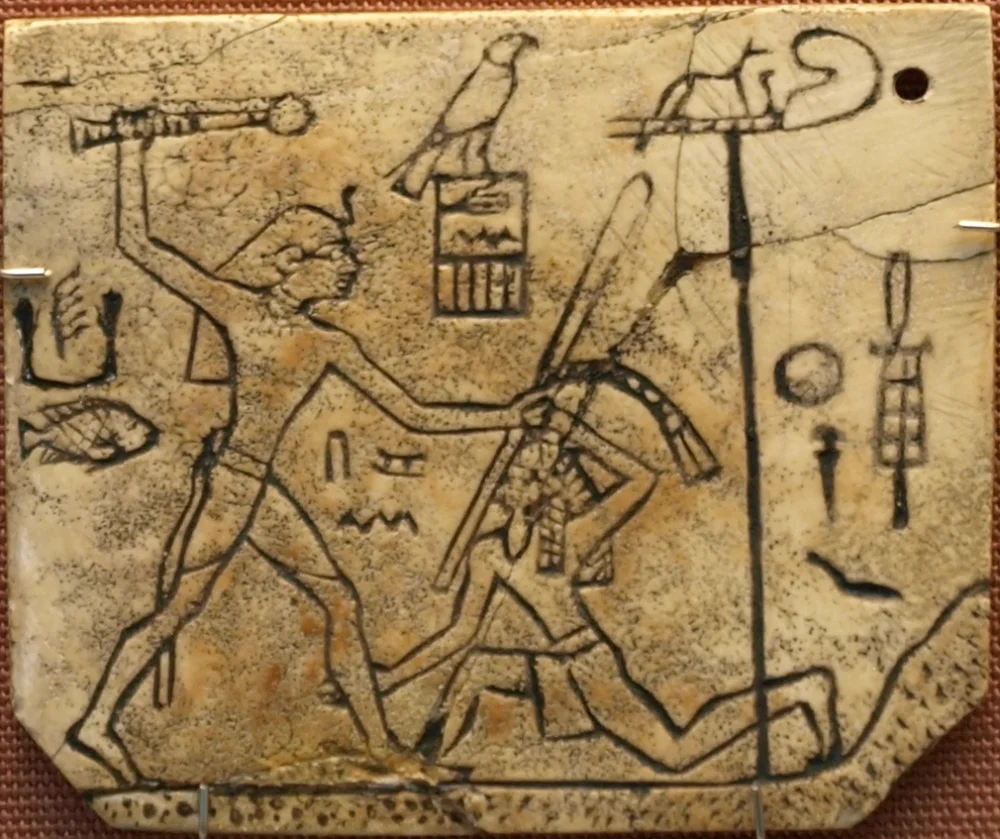
Den
Den was an early ruler of Egypt’s First Dynasty, remembered through a sparse but important archaeological record. He lived roughly five thousand years ago, when the Egyptian state was still developing its royal institutions and visual language. Small labels and sealings from his reign show a court that was already recording goods, ceremonies, and royal authority with increasing complexity.
An early Egyptian king
Den’s exact dates and personal history are unknown. He is usually placed among the rulers of the First Dynasty, around the late fourth or early third millennium BCE, though the chronology of Egypt’s earliest kings remains debated. “Den” is his Horus name, the royal name by which he is commonly identified in modern scholarship. Later sources and inscriptions preserve other forms of his name.
The surviving evidence offers little detail about his family or private life. Instead, historians reconstruct his reign from objects found in royal tombs and administrative contexts, including ivory and ebony labels, pottery inscriptions, seal impressions, and fragments of stone vessels.
The tomb at Abydos
Den’s royal tomb lies in the cemetery of Umm el-Qa’ab at Abydos, an important early center of royal burial. Its design included a staircase leading down to the burial chamber, an architectural feature that marked a significant development in royal tomb construction. Objects placed in and around the tomb point to an organized court and the resources available to the king.
Labels from Den’s tomb were attached to goods and appear to record their origin, delivery, or connection to particular royal events. They are among the earliest examples of Egyptian writing used in this way. Their images and signs are not always easy to interpret, but together they give researchers a rare glimpse of how the early state tracked wealth and represented its ruler.
Royal image and authority
Some labels from Den’s reign show him in royal scenes, including depictions associated with ritual and the defeat of enemies. One famous ivory label is among the earliest known images of a king wearing the combined crown of Upper and Lower Egypt. It suggests that royal artists were developing a visual language of unified authority, though it does not by itself tell us how complete political unification was across the country.
Other objects connect Den’s reign with ceremonies such as the Sed festival, a ritual associated with renewing a king’s strength and legitimacy. Archaeologists have debated whether he celebrated more than one such festival, which would suggest a long reign. The evidence points toward an extended rule, but the exact number of years remains uncertain.
Historical significance
Den’s reign belongs to the formative period when royal administration, monumental burial, and the use of hieroglyphic writing were taking shape. The objects associated with him do not provide a continuous narrative of battles or policies. Instead, they preserve brief records and images that reveal a growing system of authority: officials managed goods, the court marked ceremonies, and the king appeared in a distinctive visual role.
Because the evidence is fragmentary, modern accounts of Den must remain cautious. We can say more about the institutions and symbols of his reign than about his personality. Yet that record is valuable precisely because it captures a moment when the institutions of ancient Egyptian kingship were becoming recognizable and durable.